
Research frameworks
When writing a postdoctoral thesis, your theoretical framework helps you approach the research problem with a clear perspective. This page looks at three main types of frameworks (theoretical, conceptual, and analytical) and offers prompts to help you choose the right one.
These frameworks are related but not identical. Each has unique characteristics. Their terms are often mixed up, which can blur their meaning. Below, we explain the differences clearly.
Using research frameworks
Theoretical framework
This is a pre-established theory that provides a lens through which to view the data. It is used in both quantitative and qualitative studies, and it explains a phenomenon, informing the reader about themes and pattens that might be relevant. You may create your own theory, though this is less common in postgraduate study.
A theoretical framework is typically adopted before your analysis, and it:
- is the most useful for what you are investigating
- inspires the research question
- helps to make predictions about what you will find
- is generally part of the literature review or
- follows the literature review in a section titled, theoretical framework or theoretical background.
Conceptual framework
When a pre-established theory is unsuitable to investigate a phenomenon of interest, different conceptual approaches can be used in combination. These frameworks are ‘built’ from various concepts. They are often used, for example, in qualitative studies when one theory alone cannot fully explain the phenomenon being considered. It is a set of concepts and variables that jointly guide an investigation and provide insight into something.
As an amalgam of concepts, a conceptual framework can emerge during the analysis as you adopt and combine various approaches to inform the investigation. This can appear throughout the thesis or in separate sections or chapters.
Consider the metaphor of a house
A theoretical framework is a modular house made off-site and then erected on-site to match the site location. It precisely fits the location (the research aim). Rarely, it can be self-designed blueprint of the house-builder’s own making (i.e., one’s own theory).
A conceptual framework is a structure assembled on-site from various building materials (concepts) that are suitable for the job. Different parts of the house might need different construction methods as the build is complicated (i.e., the research problem is multi-faceted).
A theoretical framework sometimes leads to the need for a conceptual framework and vice-versa.
We may start with an overall lens through which to approach the research problem. The lens is drawn from established theories, which is the ‘house’ design (theoretical framework). From this, we develop a set of concrete variables and concepts needed, such as the modifications required to the house design (conceptual framework).
In this case, the ‘house’ we are building is partially prefabricated, but also partially assembled on-site!
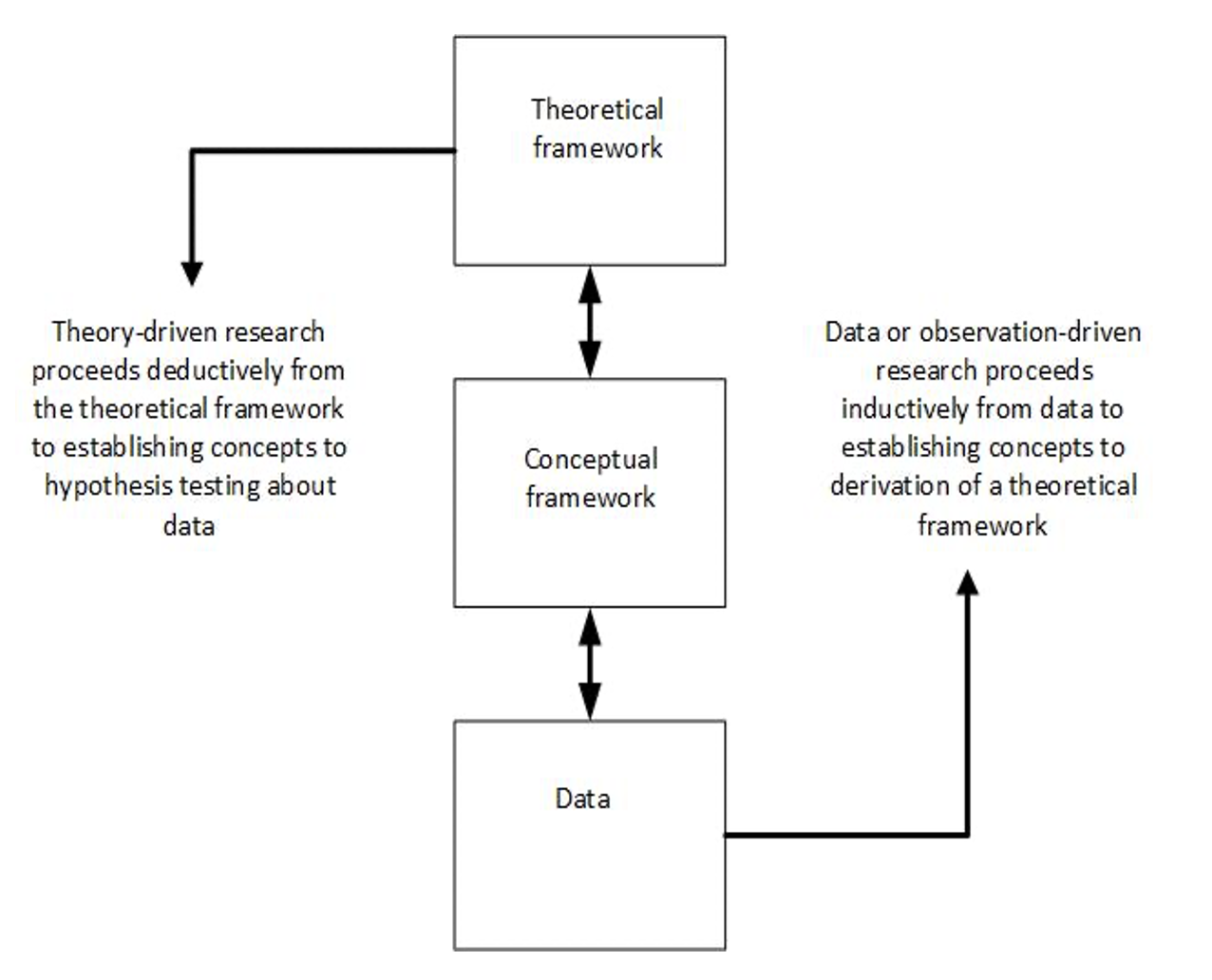
An analytical framework is used to explain how a type of analysis will be conducted. While theoretical and conceptual frameworks guide the investigation and conceptual understanding of a phenomenon of interest, the analytical framework focuses on the method of data analysis.
The analytical framework appears in the methodology section of a thesis and is grounded in the theories used. Both theoretical and conceptual frameworks inform the method of analysis used (i.e., the analytical framework).
The theoretical/conceptual framework is important for the research gap you are investigating. In the literature review, you aim to expose the research gap; the theoretical or conceptual framework then shows the reader the conceptual tool or tools you will use to address or make sense of the gap.
To return to the ‘house’ metaphor, the gap is the absence of a place to live. One needs a structure to make sense of this. The theoretical/conceptual framework tells the reader: ‘This is the structure I am using to provide shelter and warmth’. It could be any structure - an igloo, a skyscraper, a tent, or a three-bedroom brick veneer house - (any pre-existing theoretical framework). Alternatively, it could be made to your specifications, or ‘bespoke’ (a conceptual framework).
When explaining your theoretical/conceptual framework, you don’t need to outline every possible use of the theor(ies), you only use the elements of the theor(ies) you need to do the job. If you use the theor(ies) for a different purpose from that originally intended, you also need to explain why you have adapted them.
There is no specific format for writing a theoretical/conceptual framework. However, considering these questions as you write it will inform how you shape it.
1. Are the theory/theories linked clearly to your aims?
You will need to restate your aims prior to writing the theoretical/conceptual framework section(s). Your aims need to be addressed by the framework(s) and you must say how this will occur.
Do this in direct language, such as: ‘This thesis aims to … The theory of … will be used to address this aim as follows: ...’
2. What theory are you using? And what element(s) of the theory will be used?
State the theory clearly and precisely, for example: ‘Hendrickson’s theory of X will be used to …. His notion of Y will be adopted to explain how …’
3. Why have you chosen this theory as opposed to another approach?
Again, use clear and direct language: ‘The theory of XYZ was chosen because it provides a … This has advantages over the ABC theoretical approach because it enables …’
4. Can the theory be distinguished by different positions or schools of thought?
If so, these need to be made clear and the approach you are taking should be singled out, thus:
‘Hendrickson’s approach to X can be divided into several different approaches. These are as follows: …
The X approach will be adopted for this study because it …’
5. What concepts are you using?
Again, single out the relevant concept(s) and state why they are being used, for example: ‘Maslow’s concept of “self-actualisation” will be employed to explain how …’
6. How do the concepts link to your aims?
It’s one thing to identify the theories with the aims, but the concepts too must link to the aims of your thesis. Again, aim for clear language: ‘Given that the aim of this thesis is to … the use of the concept of … is clearly important because it shows that … It also provides a way of empirically analysing …’
7. How are the concepts related to each other?
Be clear and specific: ‘The concept of “assimilation” is Piaget’s notion that… This is different from his concept of “accommodation” in the following three ways: First …’
8. What ontological and epistemological outlook is implied by your theoretical/conceptual framework?
“Ontology” refers to the things you take to exist in your study; “epistemology” refers to how you create knowledge and the basis for knowledge claims. The theoretical/conceptual frameworks should make this clear. For example, do the theor(ies) presuppose naïve realism, structural or critical realism, relativism, or pragmatism? Is the basis for your knowledge claims objectivism? constructivism? subjectivism? interpretivism? Make this clear in your theoretical/conceptual framework section too.
9. What are the potential limitations of the theor(ies) you are adopting?
Acknowledge the likely limitations of your framework as well: ‘While the XYZ approach has value in explaining …, it has a number of deficits in dealing with other phenomena such as A, B and C.’
More resources
More information
Grant, C., & Osanloo, A. (2015). Understanding, selecting, and integrating a theoretical framework in dissertation research: Creating the blueprint for your “house”. Administrative Issues Journal, 4(2), 12-26. doi: 10.5929/2014.4.2.9
Pacheco-Vega, R. (2018). Writing theoretical frameworks, analytical frameworks and conceptual frameworks. https://www.raulpacheco.org/2018/09/writing-theoretical-frameworks-analytical-frameworks-and-conceptual-frameworks/
The PhD Proofreaders. (2019). Eureka! When I learned how to write a theoretical framework. https://www.thephdproofreaders.com/structuring-a-thesis/what-is-a-theoretical-framework/
White, G. (2021). Theoretical framework and conceptual framework in your doctoral dissertation [Youtube]. https://www.youtube.com/watch?v=JWb-hHInQro&list=PLnMW3VvH1_uFI0jJEAy69if0CsHLJLT0U&index=6&t=239s