
Discussion sections
The discussion is often the most important and longest part of a scientific paper, report, or HDR thesis. It shows your ability to critically evaluate your topic and synthesise research on the issue. Read on for tips to structure and write a strong discussion section.
The discussion also answers the research question(s) or confirms/disconfirms your hypothesis, which displays your informed understanding of the research issue. It provides a crucial link between the introduction, the findings and the conclusion of your paper.
It should have a specific to general structure that does the following:
- reminds the reader of your aim
- states whether your research question/hypothesis was answered
- explains the findings and shows how they answer the question
- outlines the advantages of your approach and justifies its contribution to the literature
- states any limitations of the study
- concludes by noting further work needed.
The components of the discussion might blur into each other, but they should all be present. Sections headings are not used.
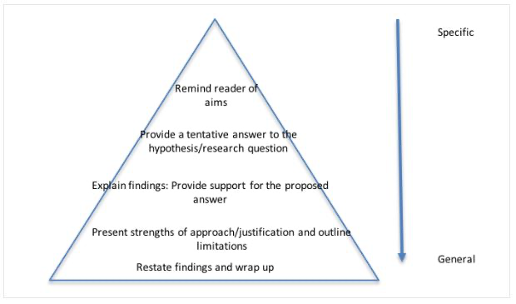
Image: Components of the discussion section may blur into one another.
Structuring your discussion section
This should be in your introduction. The aim statement recapitulation should remind the reader of the significance of your research question for scholarship in the field. State it very clearly, for example: ‘The aim of this thesis was to ...’ ‘This thesis aimed to ...’ etc.
Your tentative answer should be supported by evidence, based on previous studies and/or a summary using your results. Importantly, this section of the discussion should state whether the research question/hypothesis was answered.
Discuss the evidentiary support from the data you collected and explain the extent to which this answers your hypothesis/research question. The explanation of the findings should then outline exactly why and how the results provide an answer to the research question or hypothesis in your introduction. This involves providing an outline of the advantages, strengths and/or implications of your approach to the topic (if, that is, the findings support your approach; if they don’t, conjecture as to why this might be the case).
Furthermore, how do your findings provide an improved understanding of the topic compared to analyses that use different approaches in the literature? Here you try to justify why your study is an improvement on other approaches, and how your work contributes to the literature.
Present the strengths of your approach and briefly outline the limitations of the study that might restrict any conclusions that can be drawn from your study. The strength of your results should reiterate as to why your findings are relevant and novel in your field. While you might have adapted methodologies used in previous studies, the context and/or subtle changes you’ve implemented necessitate a new discussion.
However, it should also be noted that the limitations section needs to be included as it’s impossible to cover every facet of a research topic unless you establish what is within the scope of the research done in your thesis. This part of the discussion should be an honest appraisal about how the study could be improved and what might have been done better. This is not meant to be self-flagellation, just a balanced assessment of how future studies can learn from what you did and neglected to do. This means making some dispassionate remarks about whether you could have done something better. Weigh up whether your study could have been improved in terms of:
- the methodological approach taken
- the sample size of participants
- the geographic spread of data
- the use of various analytical tools, and so on.
Restate findings briefly and finish the section by speculating on further work that might be done in the area of research. This section might end the paper, or it might be followed by a conclusion and/or (in the case of a business report) a recommendations section.
As indicated, state where other scholars might take this research area in the future if they were to follow your approach to this area of scholarship. It’s a good idea to incorporate what parts of your research could be explored further if there were less limitations or by introducing new variables.
Language used in the discussion
In the case of a scientific report, the discussion is written using both the simple past tense to summarise findings, and the simple present tense to interpret the results and make them relevant to readers now.
Use hedging verbs to express tentativeness (‘appears that …’, ‘suggests that…’ ‘seems that’…). This is done as few reports are ever completely certain in terms of outcomes and further work is often needed.
The kind of language used in each component of the discussion are illustrated in the following examples.
In past tense:
- ‘This paper aimed to investigate … ‘
- ‘The hypothesis for this paper was …’
- ‘In this paper we proposed to …’
In past and present tesnes, with hedging verbs:
- ‘The principle of … was not followed in conducting the research about X. We originally assumed that physical decrements would be more apparent in speed jobs than in skill jobs. However, we saw that … and that there was a …’
- ‘Leaf carbon and phenolic content did not appear to differ across sites indicating that the response of secondary plant chemicals is complex. ‘
In past and present tense, with hedging verbs:
- ‘We found that … Results showed that participants might be less inclined to assist managers, if … This seemed to indicate that …
- ‘It seems that microbial activity caused immobilisation of labial soil phosphorous, however it is unlikely that…
- ‘Results seem to indicate that there was a …
- This suggests that … On the other hand, there may be a …’
- ‘This can possibly be explained by …’
In present tense with hedging verbs:
- ‘Our findings appear to contradict …’
- ‘We found there is a significant difference in how … This offers a new way of looking at …’
In past and present tense:
- ‘Our findings are not in line with … / a limitation of the study was that …’
- ‘While there is little chance of … The study is not concerned with establishing … the aim is not to … but to …’
- ‘We did not attempt to … only to look at …’.