
Introductions and research gaps
Your thesis introduction is a key section. It frames your specific area of research (the research gap), and gives your reader essential context. A strong introduction sets the scene for your research. Read on for tips to get it right.
Your introduction needs to outline the general area of research along with your specific focus of interest. In it, state your explicit research ‘gap’ and narrow down to your research question or hypothesis. This often leads naturally to a thesis statement - an explicit statement outlining your proposed argument. This can sometimes be absent from the introduction, and instead you might reveal the argument throughout the thesis; however, this is not optimal.
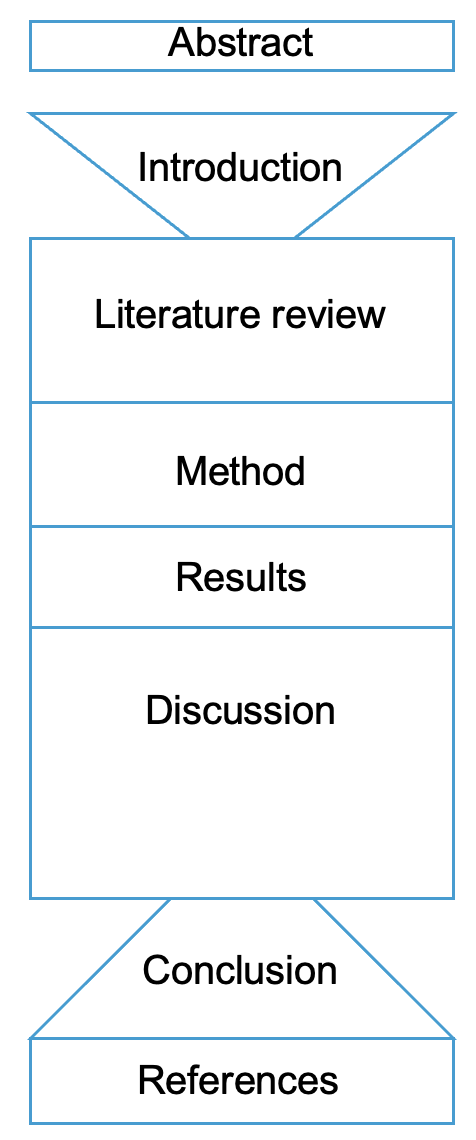 Image: Location of the Introduction in an experimental-type thesis.
While it is the job of the Introduction to expose the research gap, it is in the literature review that you explore the gap in more detail.
There are many ways to write an introduction, and discipline-specific conventions in terms of what can be included in it. In higher degree study, it is best to think of an Introduction as involving a series of stages:
- contextualisation of a problem area, or area of debate
- outline of existing solutions to the problem or approaches to the debate
- articulation of the best solution or most promising theoretical approach
- outline of the limitations of the current approach and articulation of the research ‘gap’ (i.e., what is missing or overlooked in current approaches or what could be done better)
- outline of a potentially novel approach, framed by a research question or hypothesis
- statement of the overall aim and purpose, and an outline of the proposed study.
Each of the six stages are represented in the following diagram.
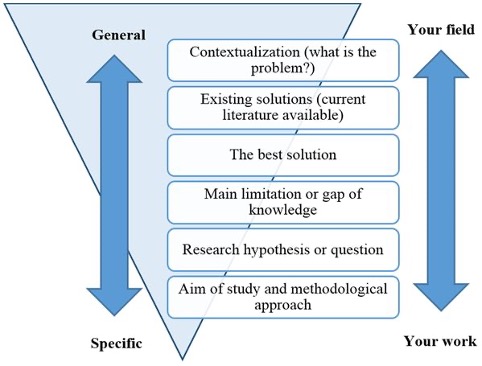
Image: The structure of an Introduction (from Bahadoran, Jeddi, Mirmiran, & Ghasemi, 2018).
Stages of an introduction
Contextualisation requires you to outline your general research area or topic and articulate why it is important. You need to convince the reader that the general context of the research warrants further, more detailed, investigation. A good introduction will pose an unresolved problem or outline a neglected area of debate within this general area that requires further discussion.
NB: Usually contextualisation occurs in two stages:
a) the general broad context, narrowing down to
b) the specific context.
This leads to the next stage.
The second stage of your introduction requires you to discuss the importance of the specific area within the general research area. You address the problem or area of debate identified earlier in more detail, then outline conventional existing approaches to the problem or debate in sufficient detail to interest the reader and leave them wanting to know more.
Typically, this stage appeals to the need for more research in the area, which leads to the next stage.
Articulating the best solution involves marshalling evidence of the most illuminating or promising solution to the problem, or the best way of understanding the debate previously identified. You must refer to scholars in the field here. Sufficient literature needs to be mentioned here to ‘hook’ the reader’s interest, but this is not the place for a review of the literature - that follows the introduction in a separate chapter, the literature review.
The fourth stage of your introduction should then outline why the most promising current solution, or theoretical approach, falls short or is inadequate. This is called the ‘gap’. This requires sufficient exposition of the approach for the reader to find the criticisms of it to be believable and well-grounded. (Again, a more detailed critique will be given in the literature review).
It is the job of the introduction to expose the gap; it is the job of the literature review to explore it in detail.
You then move beyond the inadequacies of the current approach to outline a proposed new solution to the problem or a new way of understanding the debate.
This should lead to your research question, or a formal hypothesis statement (in the case of the empirical sciences).
This section usually provides a statement of the aim and purpose of your study (‘This thesis aims to …’). It may also mention the methodological approach you have adopted (but leave details to the methods chapter).
The aim statement formally states:
- the proposed original contribution the thesis makes to the specific area of research
- the purpose statement outlines why you are doing the research, and explains how the contribution will benefit, or otherwise expand scholars’ understanding of the field.
This section also provides an overview of the direction of the thesis or paper in terms of outlining what will be done in each chapter that follows.
Ideally, your thesis introduction will also outline the argument your thesis makes in the form of a thesis statement. This is more precise than an aim statement. It articulates the argument made in the form: 'The thesis argues that …'. But this expectation varies depending on the discipline area, so that is not included here.
Further reading
Bahadoran, Z., Jeddi, S., Mirmiran, P., & Ghasemi, A. (2018). The Principles of Biomedical Scientific Writing: Introduction. International Journal of Endochrinology and Metabolism, 16(4), e84795. https://doi.org/10.5812/ijem.84795