
Literature reviews for postgraduates
A literature review presents and evaluates major research and theories in your field. It tells the story of what’s been studied and shows where your work fits. Think of it as a focused map of existing studies arranged around your research question or the gap you aim to address.
At postgraduate level, its main purpose is to uncover the research gap, the area your study will address. This often works alongside your thesis introduction to set the context for your research.
A literature review can eventually form a major chapter, or sometimes several chapters of a student’s higher degree thesis.
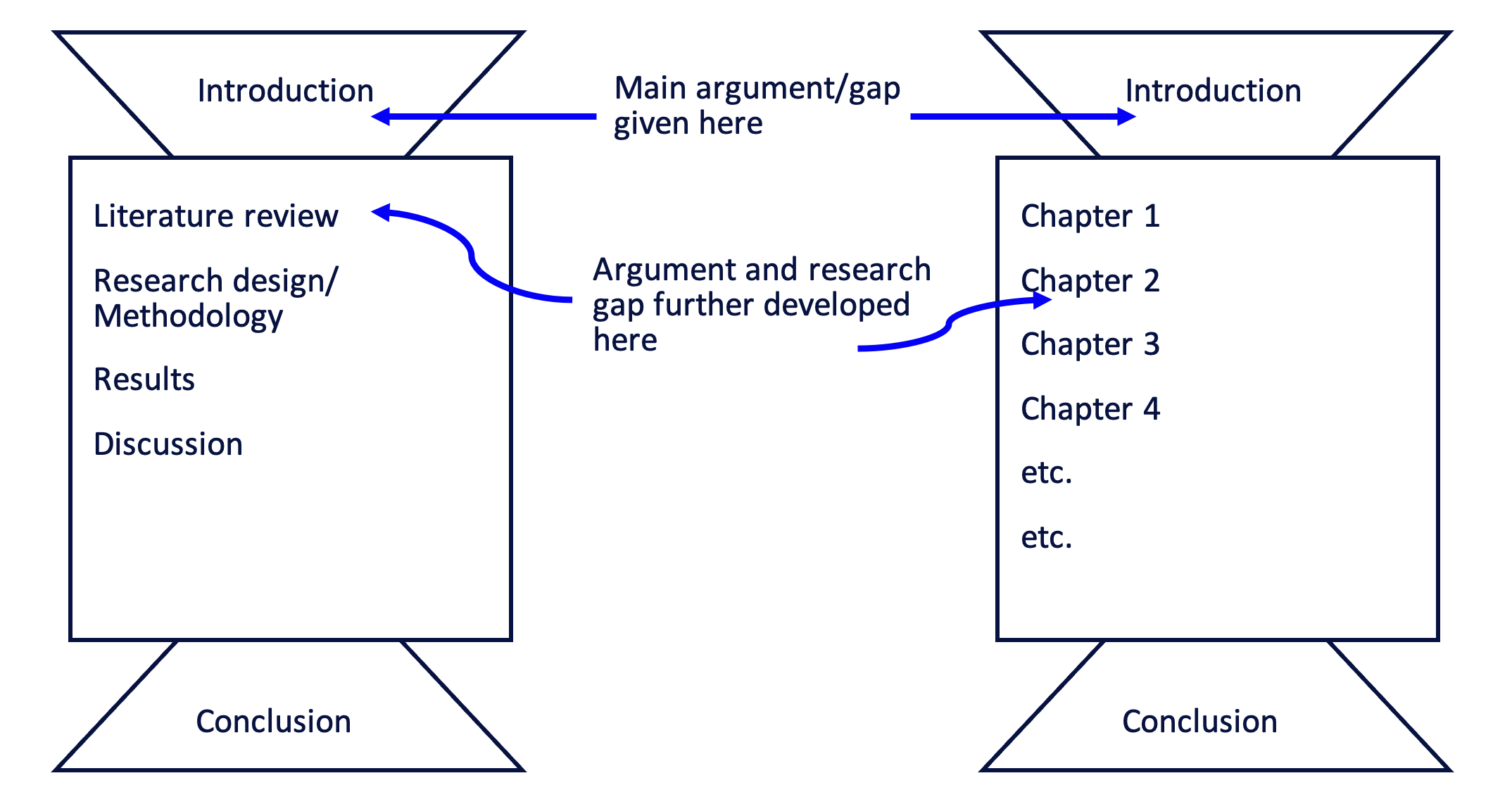
Image: How a literature review might appear in different thesis types
A postgraduate literature review will consist of many article reviews combined where you compare article “X” with articles “Y” and “Z”, and so on, in relation to your topic. It should be noted that they are not set out separately like an annotated bibliography, critical review, or reading log. You want to end up with one document that combines relevant information from each of the articles.
In a literature review, the work of others is integrated into a coherent whole, typically divided into themes. For an undergraduate student, a literature review is much less extensive and demanding. It may be that the first draft of your document reads like a mess of unstructured ideas. This is normal for a first draft. It will require several drafts to get it right.
Structuring your literature review
A literature review summarises, interprets and evaluates existing literature to establish current knowledge about a subject. It often has multiple purposes. A literature review must:
- define and place limits on your research problem
- not duplicate or repeat material by clustering discussion about similar authors
- concentrate on key ideas relevant to your project, not marginal or tangential ones
- evaluate promising research methods, which provide a rationale for your research approach
- relate your findings to previous knowledge and suggest further research.
A literature review does more than describe. Rather, it should:
- compare and contrast different authors’ views on an issue, noting areas in which they disagree
- critically evaluate strengths and weaknesses of the methodologies and findings of previous research
- highlight exemplary studies (i.e., key works that advance the discipline)
- identify gaps in research
- show how your study relates to previous studies
- conclude by summarising what the literature says.
The literature review may, in addition:
- place your study in an historical perspective
- resolve a controversy
- establish the need for additional research
- define a topic of inquiry
- outline theory and list relevant hypotheses
- make recommendations for future research
- outline a practical problem that needs resolution.
Owing to these expectations, the literature review is a complex and challenging writing task. Read on as we outline the stages to writing an effective one.
First, put limits on your search of the literature by designing a narrowly focused research question. A good research question will not be ‘closed’ resulting in a Yes-No response, such as, ‘Should the Constitution be changed so that the President of the US serve more than two terms?’ (a closed question). Open research questions require a discussion, and this is what you want to aim for—a topic that engenders debate.
Suppose your broad topic area is ‘Euthanasia’. You will be expected to narrow down the topic to something much more focused, such as: ‘To what extent should people have the right to die in a manner and time of their choosing?’.
In some disciplines it is important that the research question is testable; in others, the ‘research question’ is instead an hypothesis that must be confirmed or disconfirmed. Either way, it must be narrowly focused: You are aiming to create a question or hypothesis that invites a nuanced investigation into the various factors at play, which fosters a more comprehensive discussion.
Once you have a narrowly focused research question, you need to consult research databases to find several key papers in this narrow field of interest. As you gain more of an understanding of your topic, you will need to catalogue and collect more data. Consider using the following programs, which can help you with this.
- Zotero and EndNote are great for reference management as you can create organised folders that relate to a theme that a journal article aligns with.
- Elicit is a paid AI research assistant that summarises academic papers, finds relevant data, and generates insights which can automate systematic reviews and meta-analyses.
- Research Rabbit is a free, research discovery tool, that uses AI in the exploration of journal articles, visualising similarities between separate studies, and finding relevant literature to develop an even deeper understanding of the topic.
- ExplainPaper is another paid AI-powered platform designed to simplify complex academic papers, allowing users to upload documents and receive explanations of technical or dense content in a way that can be easily interpreted.
It should be noted that these programs/platforms that use AI have shortcomings and are not meant to be used as the sole resource when conducting a literature review. It is still essential for you to develop expertise in your field of interest. AI tools can miss nuances, misinterpret the findings of the articles by overlooking important context, or not understanding the variables in a result. Always cross-check summaries with the full text to ensure depth and accuracy, which allows you to have a thorough review. This is of utmost importance when it comes to credible research.
The next step is to write several annotated bibliography entries for each article you plan to review. This is essentially a summary and short commentary on each article. In doing this, you should be able to see common themes and positions in the author’s argument. Some will be defending one position; others will be defending a different position; others will be defending a position that seems to combine disparate elements of others. The next step is applying the ‘Yes-BUT’ method.
The ‘Yes-BUT' Method
This method involves categorising the literature you have collected and annotated. As you read articles on your topic, you may start to see articles that defend the proposition that people should have the right to die in a manner and time of their choosing. You might start off agreeing with this, so it becomes your tentative thesis statement. This is the position you may want to defend in your literature review.
But of course, you must dispassionately consider arguments and evidence against this view. And you must carefully weigh up the pros and cons and explore the various themes relevant to the topic area.
But a literature review must do more than argue for a position - it needs to uncover a research gap. This is the contribution that you will make in your thesis. Canvassing the various positions that exist in the literature is preparation to finding a gap and working out where new contributions are needed.
For now, write the tentative thesis statement at the top of a piece of paper (or on a Word document; see example below). The headings ‘Yes’, ‘No’, Yes BUT’, and ‘No BUT’ are the various possible responses to your proposition. Start reading the literature again. As you read, put sources into categories depending on whether they agree/disagree or partly agree/partly disagree with your tentative thesis statement:
- ‘YES’ literature agrees with the statement and offers arguments and evidence to support it.
- ‘NO’ literature does the same in opposition to the statement.
- ‘Yes BUT’ literature is on the ‘YES’ side of the issue but raises major concerns or reservations about it.
- ‘No BUT’ literature is on the ‘NO’ side of the issue but has major concerns or reservations about it.
This schema can be made subtler again, e.g., you might also include ‘NO but (i.e., small but)’ and ‘YES but’ literature (i.e., these are closer to the ‘NO’ and ‘YES’ positions and have fewer reservations or concerns). Set out the literature so you are clear who says what. Note the authors’ names and publication details to keep a catalogue of possible references you can use in your literature review.
You are starting to build a picture of different positions taken on a given research question. See example below.
| Topic | Euthanasia |
| Initial thesis statement | People should have the right to die in a manner and time of their choosing |
| Yes | Simple (2020); Jenner and Smith (2021) |
| Yes BUT | Facacino (1998); Maverson and Edge (1999) |
| No BUT | Bastion and Levers (2023) |
| No | Marginson (2024); Homer (2021), Rasputin (2019) |
*Reference details might be added in a reference list below the table. Note: The list of literature will typically be much more extensive than this example.
As you read, you might start rethinking your initial response to the literature. You may even change your view entirely. This is productive – you may find that the issues and evidence raised are more complex and subtle than you initially thought. Importantly, you might find that while various views are canvassed in the literature, there has been relatively little work done in certain areas of the debate. For example, you might find that while a lot of work has been done on palliative care, not much work has been done on the use of mindfulness in treating terminally ill patients. This might influence your initial views about the topic, and after more reading you may decide to revise your initial thesis statement.
And if you were to change your thinking based on what you have found, you have moved from the “Yes” camp to the “Yes BUT” camp.
If you were to find, for example, that there is good evidence of effectiveness using mindfulness to treat terminally ill patients, then this is your research gap. You have found a unique angle on the topic. This can be where you make your contribution. Whatever position you decide to defend, ensure that the research gap is clear. This should be foregrounded in your discussion of the various perspectives in your literature review. You can add this to your table:
| Topic | Euthanasia |
| Second version of thesis statement | People should have the right to die in a manner and time of their choosing if mindfulness as a form of palliative care is unsuccessful in helping patients come to terms with their prognosis. |
| Gap | The use of mindfulness as a form of palliative care in treating patients with terminal illnesses |
| Yes | Simple (2020); Jenner and Smith (2021) |
| Yes BUT | Facacino (1998); Maverson and Edge (1999) |
| No BUT | Bastion and Levers (2023) |
| No | Marginson (2024); Homer (2021), Rasputin (2019) |
Now you have refined your search of the literature by establishing a gap, you might want to redo the table by drilling down into the literature further with a closer focus on mindfulness literature in euthanasia.
Note: Literature examples have changed to show how the focus has shifted.
| Topic | Euthanasia |
| Second version of thesis statement | People should have the right to die in a manner and time of their choosing if mindfulness as a form of palliative care is unsuccessful in helping patients come to terms with their prognosis. |
| Gap | The use of mindfulness as a form of palliative care in treating patients with terminal illnesses |
| Yes | Jamison (2012); Hendrix (2019) |
| Yes BUT | Hilderguard (2019); Boisin (2011) |
| No BUT | Histon (2017); Smith (2015) |
| No | Kennedy (2017); Franks (2001) |
It may be that you need to refine your gap and search even further.
Moving from this to actually writing the review can seem daunting, but it can be made easier by producing discrete summaries using the Yes-BUT method and following this with critical reviews (or summary and critiques), and finally, an outline of your literature review.
If you are not confident moving straight to writing the literature review from the annotated bibliography entries, write a critical review for each article. This essentially extends your annotated bibliography entries with much more detail. You need to produce documents that both: a) describe and summarise the detailed arguments and evidence of individual published papers in your narrow area of interest; and b) critique them, i.e., note what you think is good about each article and what could be improved, or where the evidence and arguments are dubious. For this you will need to do some critical thinking. It helps to map the arguments of the various papers you are reading and use this to decide which claims are objectionable.
Once you have written your critical reviews, go back to the step of applying the Yes-BUT Method. You should be more informed about the literature now.
The next step is to design a writing outline that gives shape to your literature review. Attempts have been made to outline writing taxonomies for graduate students. These show nested relationships between ideas and support for ideas using commonly used linking phrases (Rochecouste, 2005).
Design taxonomies can be used to help shape a literature review. A good way to think of a design taxonomy is as a series of nested categories with ‘vertical’ and ‘horizontal’ axes. The vertical axis are the ways literature is carved up. The ‘horizontal’ axis consists of the theorists and studies that are representative of the various vertical categories.
A simplified example is provided below: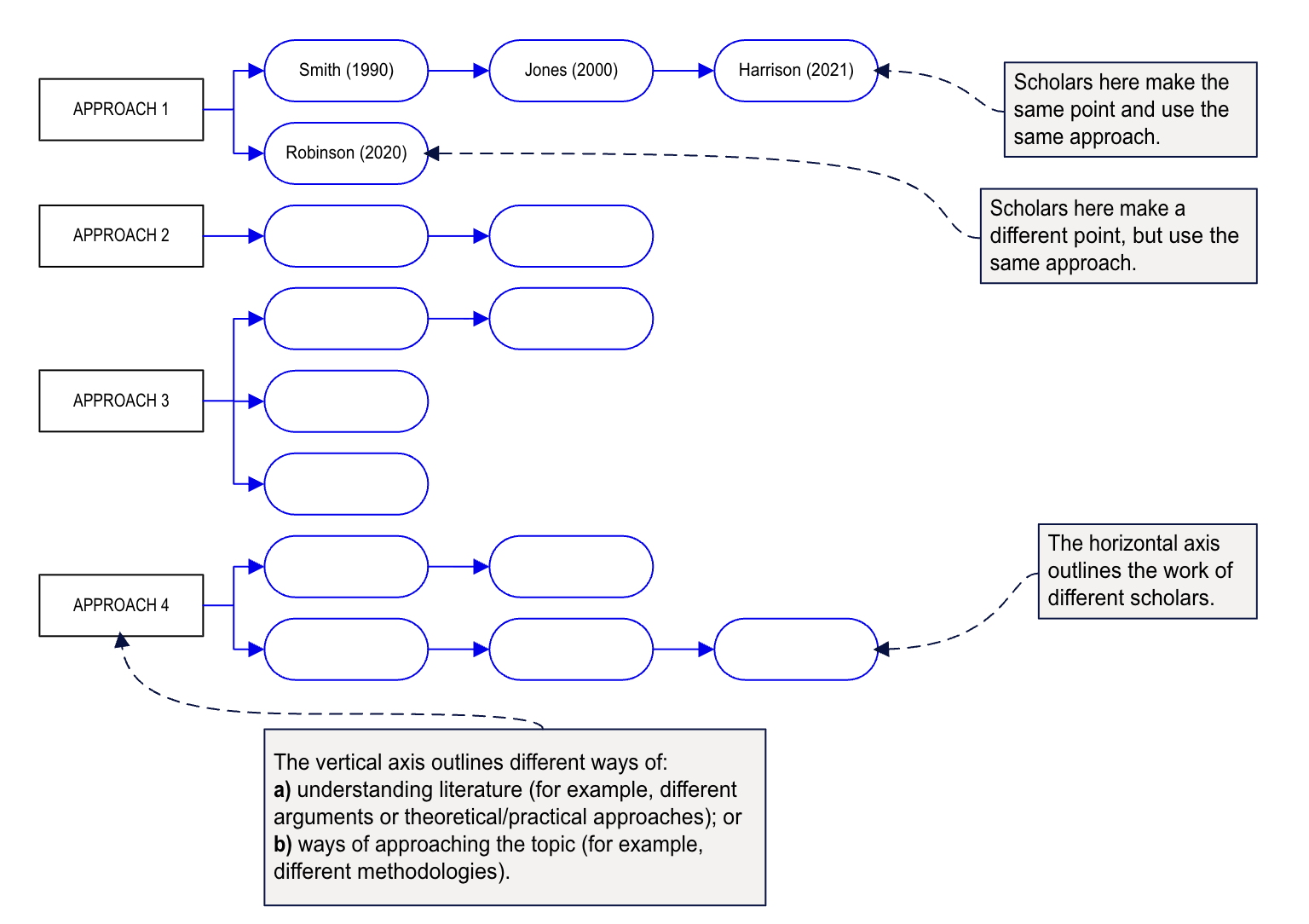
Image: Design taxonomies, simplified example.
Here are some other possible vertical axes you might consider:
-
- Methodology a
- Methodology b
- Methodology c
...
-
- Arguments for
- Arguments against
- Arguments partially for and against
...
-
- Theme 1
- Theme 2
- Theme 3
...
-
- Earlier approaches
- Middle period approaches
- Later approaches
...
-
- Quantitative studies
- Qualitative studies
- Mixed method studies
...
-
- Empirical studies
- Theoretical approaches
- Case studies
...
Or any number of other variations.
Fortunately, with the Yes/No-BUT table you are well on the way to devising a writing taxonomy. The vertical categories suggested by the previous Euthanasia example are:
- Arguments for
- Arguments partially for and against (combining Yes BUT and No BUT)
- Arguments against
Fleshed out with the horizontal axis examples from the literature and adding an introduction and conclusion, this becomes:
Introduction
Arguments for
Jamison (2012)
Hendrix (2019)
Arguments against
Kennedy (2017)
Franks (2001)
Arguments partially for/against
Histon (2017)
Smith (2015)
Hilderguard (2019)
Boisin (2011)
Conclusion
You might place the NO literature prior to the Yes/No-BUT literature, or after it, depending on how you wish to emphasise the literature. If you are adopting a position between the extremes, it makes sense to finish with literature that adopts a subtle position like your own.
Suppose that you decide when reading the literature that there is another way of carving it up. You might find that there are papers that outline concrete findings (data) on mindfulness as a treatment approach for terminally ill patients, and papers that outline more theoretical approaches on mindfulness as a form of treatment in palliative care. The articles offer empirical and theoretical approaches to the issue rather than arguments for and against (or partially for/against).
These empirical and theoretical approaches become the categories of the vertical axis. You can now cluster the findings together and cluster the theoretical approaches separately.
These comprise our vertical categories as follows:
| Topic | Euthanasia |
| Second version of thesis statement | People should have the right to die in a manner and time of their choosing if mindfulness as a form of palliative care is unsuccessful in helping patients come to terms with their prognosis. |
| Gap | The use of mindfulness as a form of palliative care in treating patients with terminal illnesses |
| Findings |
Simple (2020); Jenner and Smith (2021); Bastion and Levers (2023) |
| Theoretical approaches | Facacino (1998); Maverson and Edge (1999); Marginson (2024); Homer (2021), Rasputin (2019) |
Turning this into a structure for a literature review is easy. It involves nesting the horizontal elements under the vertical categories as follows:
Introduction: Outline of aim of LR and gap in research
Findings
Simple (2020)
Jenner and Smith (2021)
Bastion and Levers (2023)
Theoretical approaches
Facacino (1998)
Maverson and Edge (1999)
Marginson (2024)
Homer (2021)
Rasputin (2019)
Conclusion
This review has outlined the .... [summing up of the various perspectives]
Following on from here, a simple structure might look something like this:
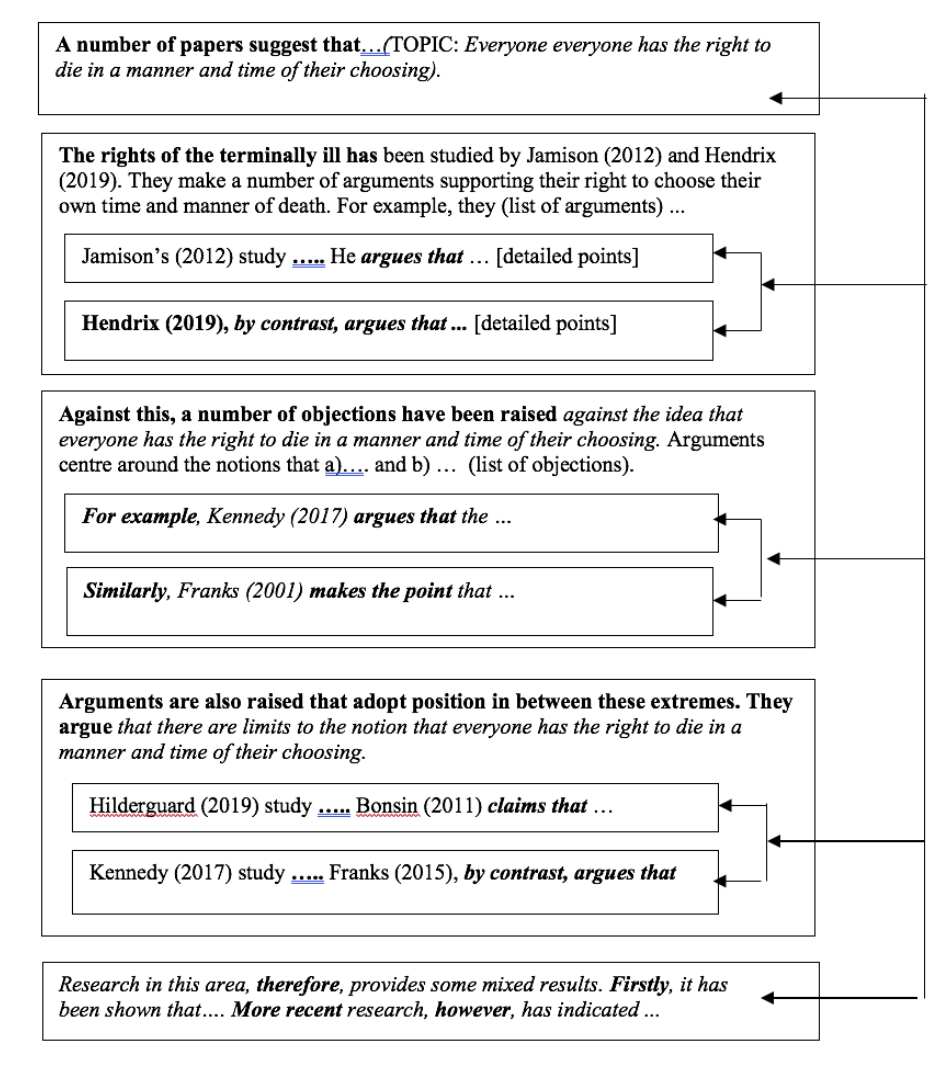
Image: Example of a writing taxonomy on the topic of ‘euthanasia’
Adding some connecting language then can introduce the vertical axes and each section. This way, the structure becomes even more like the beginnings of a literature review.
For example
Introduction
[Overview statement]
Several studies have argued that [thesis statement for sub-topic] mindfulness is an important strategy when treating patients with terminal illnesses. Some studies have reported [outline of vertical categories] findings from empirical research. Others have provided theoretical contributions that support the use of mindfulness in palliative care contexts. Each of these will be discussed below.
[Gap statement]
While literature has looked at ...., little work has been done on the use of mindfulness as a treatment option.
[Drilling down to the first vertical axis category/Overview of the findings]
The empirical findings range from findings that attempt to .... (Simple, 2020), to findings that adopted an approach of ... (Jenner and Smith, 2021). Other findings in the area of ... have also been adopted by Bastion and Levers (2023).
Findings
Simple (2020), for example, has looked at ... He found that .... [detailed findings]
Jenner and Smith (2021), by contrast, have found that ... [detailed findings]
Bastion and Levers (2023), have also looked at ... but their meta-analysis indicated that ... [detailed findings]
[Drilling down to the second vertical axis category-overview of the theoretical approaches]
Theoretical approaches to the topic have investigated the concept of ‘mindfulness’ and how it ... (Facacino, 1998). Other studies have looked at the link between mindfulness and ... Maverson and Edge (1999). While others have adopted a theoretical approach involving.... (Marginson, 20024; Homer, 2021) and ... (Rasputin, 2019).
Theoretical approaches
Facacino (1998) outlined the theoretical approach of [details of approach]
Maverson and Edge (1999) used the ... [details of approach]
Marginson (2024), by contrast, attempted to provide an account ... [details of approach]
Homer (2021), concurred with Marginson, however, added that .... [details of approach]
Rasputin (2019), however, adopted the approach ... [details of approach]
Conclusion
[Summary of all approaches in the literature]
This review has ... Research in this area indicates that ... etc
This is a simple example; your literature review will be much more extensive and detailed.
In addition to a) canvassing a variety of perspectives on the literature; b) determining where you stand on the literature; and c) identifying a research gap, aim to progressively narrow your literature review. The review should not get broader. It should get more refined and more focused and detailed as you progress. See diagram below.
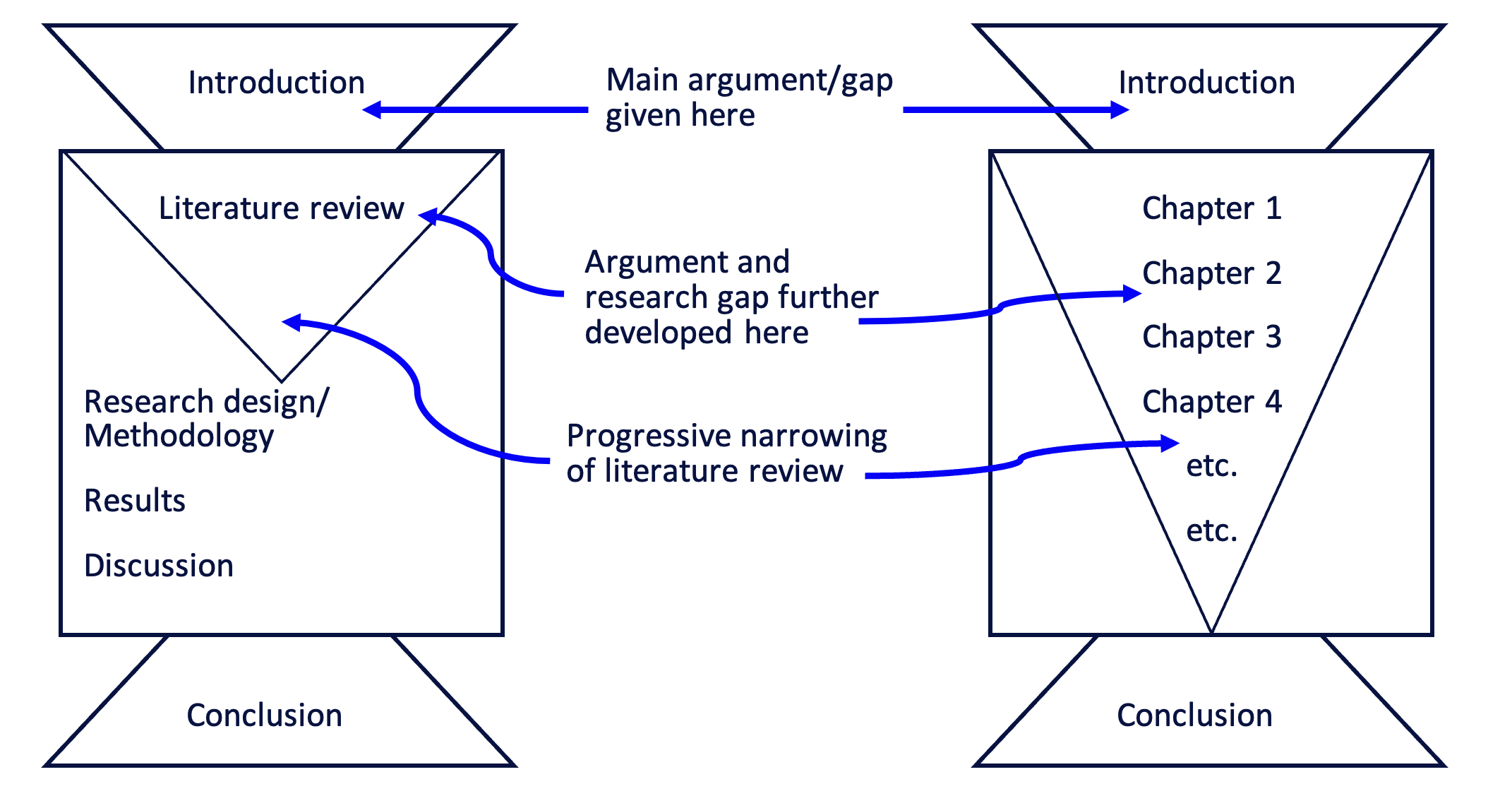
Image: Progressive narrowing of the literature review in two different thesis models
If, for example, your research gap is the neglect of the importance of mindfulness as a way of providing palliative care for terminally ill patients, the review would:
- canvas the various arguments for and against euthanasia, considering and rejecting all the arguments for it, and doing the same for most of the arguments against it
- focus your attention on the palliative care argument against euthanasia and look at this in detail
- look at the various positions on the importance of palliative care as a mitigating variable
- focus on the various arguments for and against palliative care
- note the neglect of mindfulness in the research literature on palliative care
- look at the extant literature of mindfulness as a palliative care technique
- look at what other scholars have done/failed to do
- make your case for why it should be considered (or reconsidered), which leads naturally to your study as provided in the rest of your thesis.
In this way, the literature review provides a justification for why your study is needed.