
Mapping an argument
Constructing a clear argument is essential for a successful doctoral thesis. A PhD thesis always conceals an argument within the claim it is making. When someone asks, “What’s your thesis about?” your answer will likely start with: “My thesis argues that [...]".
First, let’s consider the definition of an ‘argument’. It is generally one of two things:
a) a verbal fight, or
b) a connected series of statements that together allow us to infer a conclusion or contention.
In the context of a doctoral thesis, it is the second of these definitions that we mean here, illustrated beautifully in Monty Python’s famous argument sketch.
Your PhD thesis supplies the argument, coupled with supporting evidence. Many variations are possible in the structure of a thesis; however, often the argument occurs at the start and evidence is provided for it in subsequent chapters.
In another thesis, the argument could be sustained throughout its entirety, with every chapter illuminating some element of the argument (or providing subsidiary arguments for an overarching argument). These two versions are illustrated below.
Typically, the argument is articulated in the Introduction and research gap section of the thesis and the literature review. It is also outlined in the discussion and revisited in the conclusion.
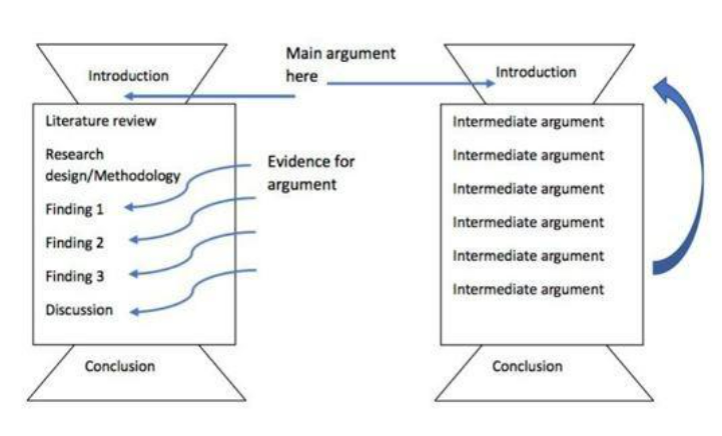
Image: Two ways in which arguments can be incorporated into PhD theses.
Building and structuring your argument
In academic writing, an argument is built by offering a series of statements that are linked. They cannot be disconnected or be unrelated to each other; having links between them is critical! These links are known as inferences.
If you state that 'Christmas should be banned', this is not an argument. It is only one statement. It is not connected to other statements. (A statement that occurs on its own is sometimes called an unsupported assertion).
If you were to state, 'Christmas should be banned and eggs are better fried', you are making two statements: 1) 'Christmas should be banned' and 2) 'Eggs are better fried'. These are two disconnected assertions with no clear link between them, so it is not an argument. There is no explicit or implicit link between the two statements, therefore they are just two unsupported assertions.
If you state that 'Christmas should be banned because it has become too commercial', you have connected two statements together with an inference, inferring from 'Christmas has become too commercial' to the conclusion that 'Christmas should be banned' (or to put it another way, you are concluding that 'Christmas should be banned for the reason that Christmas has become too commercial'). By joining them with the word ‘because’ you are giving one statement as a reason for the other. This is an argument, although it is not a very interesting one.
However, note that you are also tacitly assuming a third statement, that 'Anything that has become too commercial should be banned'. A tacit supporting premise is called a co-premise. The inference is the connection between the three statements.
The argument and the inferential connections can be rendered clearly as follows:
Christmas has become too commercial.
Anything that has become too commercial should be banned.
Therefore, Christmas should be banned.
Together these three statements are called a syllogism.
Rendered as an argument map, the argument looks like this:
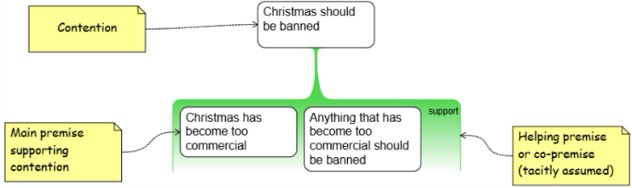
Here are some definitions of argument-related terms:
- A contention is a claim that you argue for and want to support (this is also called a conclusion in an argument).
- A claim (or premise) is a statement in an argument either supports or opposes a contention
- A statement in support of a contention is called a reason
- A statement against a contention is called an objection
- A statement against an objection is called a rebuttal
- An inference is the connection between the reason and the contention, i.e., that allows us to draw a conclusion from the reasons provided. Inferences are identified by means of inference words
- An inference word (or phrase) is a linking expression that indicates an inference is being made.
Inference words and phrases are used to connect premises (reasons/objections/rebuttals) to contentions, and to connect contentions to premises. These indicators can signal that what goes before is a premise, and that what comes after is a conclusion:
- (premise) …because… (conclusion)
- (premise) …shows that/is shown by… (conclusion)
- (premise) …indicates that… (conclusion)
- (premise) …proves that… (conclusion)
- (premise) …entails that… (conclusion)
- (premise) …implies that… (conclusion)
- (premise) …establishes that …(conclusion)
- (premise) …allows us to infer that… (conclusion)
- (premise) …gives us reasons for (conclusion)
An indicator can also signal that a conclusion which comes before has as its premises some statements which come after:
- (conclusion) …is shown by… (premise)
- (conclusion) …is indicated by… (premise)
- (conclusion) …is proven by… (premise)
- (conclusion) …is entailed by… (premise)
- (conclusion) …is implied by… (premise)
- (conclusion) …is established by… (premise)
The following short passage shows the use of inference indicator words in context:
Evidence from public health suggests shows that the public should be concerned about a rising rat population. First, the presence of rats shows that a rising rat population is an economic issue. They damage utility lines and wires, start fires and damage a lot of a city’s infrastructure in locations we can’t observe as indicated by damage to sewer walls or under sidewalks. Secondly, it’s a public health concern because rats roam the sewer systems and carry all kinds of germs. With a higher number of rats it can be assumed that our chance of coming into contact with those germs increases. Third, a rising rat population is an aesthetic issue. The presence of rats entails, and is a common indicator of, a degraded environment.
Working out the contention of an argument involves looking for conclusion indicator words. Sometimes, “therefore” or “hence” or “thus” is used, and the contention is obvious. But these words are not always used.
Arguments can be made clearer by means of argument maps. This is a visual way of displaying conclusions, reasons, objections, rebuttals, and inferences. Being able to map your argument is helpful in thesis writing as it helps you to clarify what you are trying to say. Making an argument map forces you to make an argument as opposed to simply describing information.
In general, an argument map can be explained as follows:
- a contention is provided at the top of the map; and
- as many reasons as required are provided in support or against a contention below it;
- there is an inferential link between the reasons and the contention.
In this example, the link is the word 'because'.
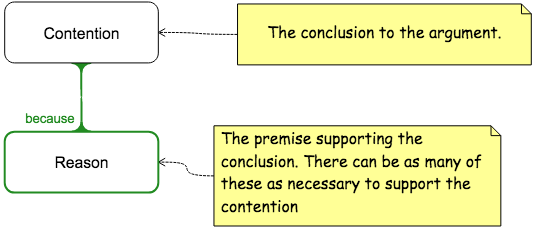 Simple argument maps
An argument map can come in simple and complex forms. A simple argument has one reason that is given for a contention (or conclusion). Below it is argued that 'It is a good time to invest in property because interest rates are very low'. The contention is at the top of the map, the reason is given below it. The inference word is 'because'.
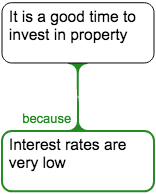
Simple argument with one reason
Complex argument maps
Below is a more complex argument with more than one reason:
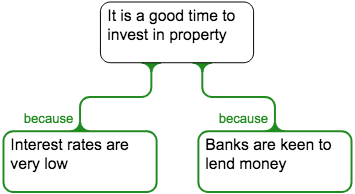 A more complex argument with two reasons
Note that there are separate reasons here: 1) the 'interest rate' reason; 2) the 'keenness to lend' reason. In argument maps you must clearly separate different reasons and allocate them to separate reason boxes.
Below is a much more complex argument for the contention that 'Research into genetically modified food is a good thing'. Notice here that objections are given to the contention, and reasons supporting the objections are provided.
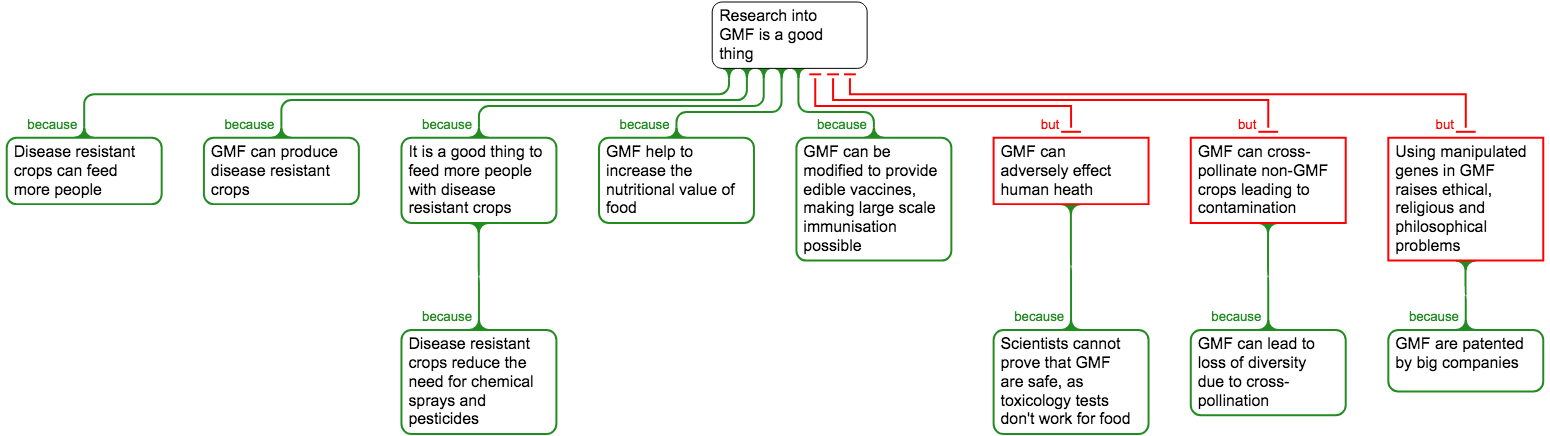 An argument for and against the contention that 'Research into genetically modified food is a good thing'
Evidence is provided in arguments as they provide support to reasons. The reason 'Interest rates are very low' would need to be supported with evidence, e.g., the current official cash rate provided by the Reserve Bank. The reason 'Banks are keen to lend money' could be supported with a media report about bank enthusiasm for lending.
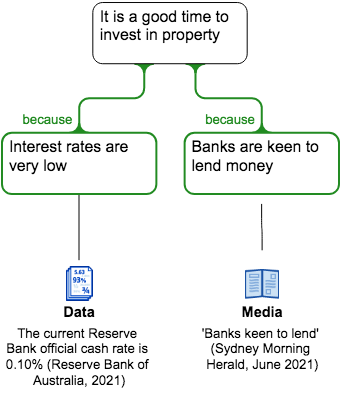 Complex argument with evidence supporting reasons
Evidential sources can also be supplied to objections to contentions as well as the following example shows:
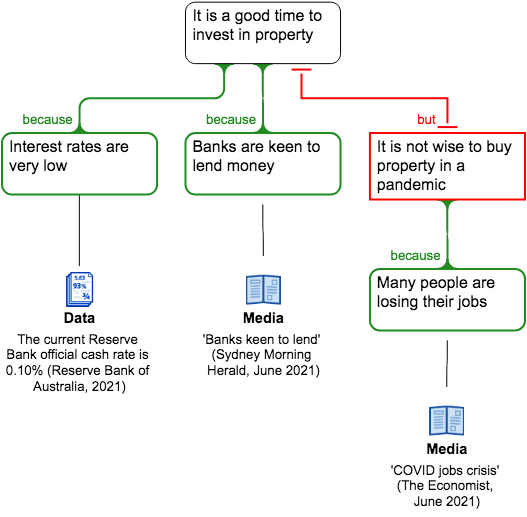 A complex argument with an objection with supporting evidence
Sometimes many evidential sources are needed to back up the reason(s) being made. It is conceivable that multiple evidence sources might be needed to back up some reason, but typically one or two sources of evidence are sufficient:
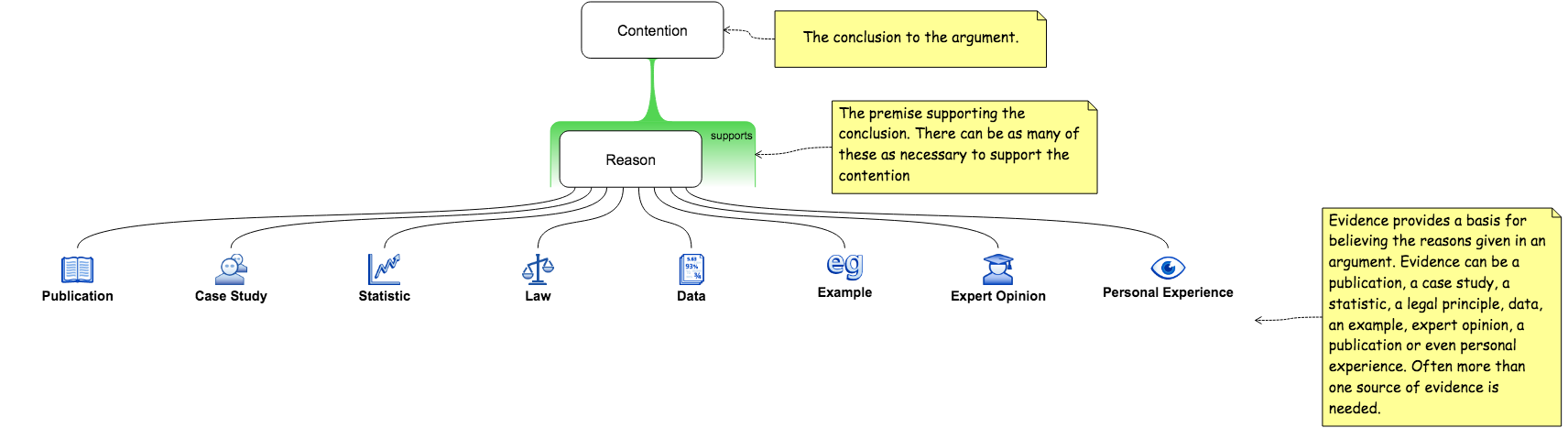 The strongest sources of evidence in academic scholarship are peer-reviewed research publications, and experimental data, but other sources of evidence are possible depending on the discipline area, e.g., case study evidence and legal judgments might be appropriate in some contexts.
A premise is another word for a reason in an argument. A co-premise is a reason that helps another reason. Sometimes co-premises seem trivial as they are below.
Note that co-premises are shown in argument maps as a helping reason under ‘umbrella’ shading:
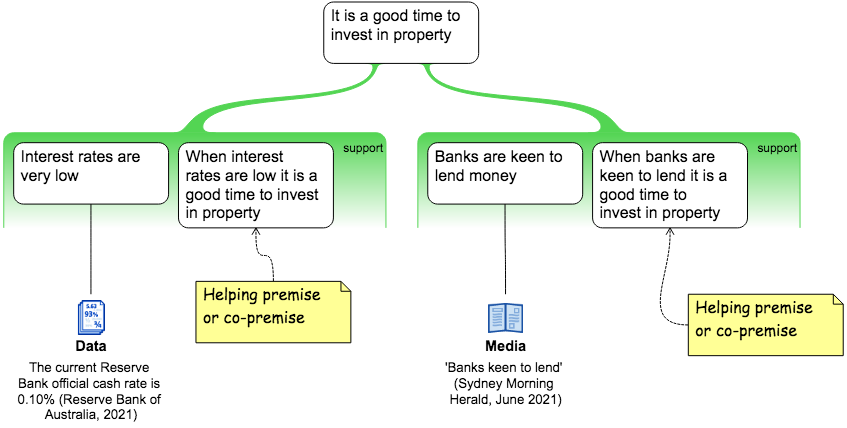 Complex argument with co-premises supporting the main reasons
Providing co-premises makes the argument tight. The logic of the argument can be easily seen. If it is accepted that 'Interest rates are low' (reason) and if it is the case that 'When interest rates are low it is a good time to invest in property' (co-premise) it can be concluded that 'It is a good time to invest in property' (contention).
Of course, none of these claims might be right. If so, objections can be made to them. This is good. This means you are getting your argument clear. You will need to find evidence for your objections of course. But responding to assumed co-premises by rebutting them or calling them into question helps to make your reasoning more precise, clear and explicit.
On other occasions a co-premise is not trivial at all and can be the source of an error in reasoning. A good argument map will make all co-premises explicit. Doing so will allow you to see flaws in your reasoning.
For example, if I contend that 'Dogs make better pets', based on reasoning that 'Dogs like to play' (because 'Dogs fetch balls'), and assume the co-premise 'Pets you can play with make better pets' is the reasoning compelling? It isn’t. Old people don’t necessarily like playful pets. The helping premise, 'Pets you can play with make better pets' need not be accepted. Your challenge when mapping your discipline-specific arguments is to make all co-premises explicit.
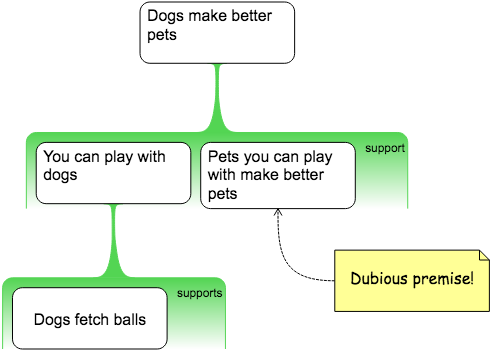 Argument with a dubious co-premise
Complex arguments can be considered in terms of argument units which, when combined, give rise to larger argument structures. In these complex arguments, intermediate conclusions give rise to final conclusions.
An example is provided below. In this case, one argument unit is comprised of premise A1-b which is supported by premises 2B-a and 2B-b. Premise 2B-a, in turn, is supported by another argument unit comprising premises 3B-a and 3B-b. Another argument unit is comprised of premise 1A-a which is opposed by premise 2A-a and 2A-b. Yet another argument unit consists of premise 2A-a, which in turn, is rebutted by premises 3A-1 and 3A-b. All four argument units contribute to the main argument unit comprising 1A-a and 1A-b which provide support for the main conclusion.
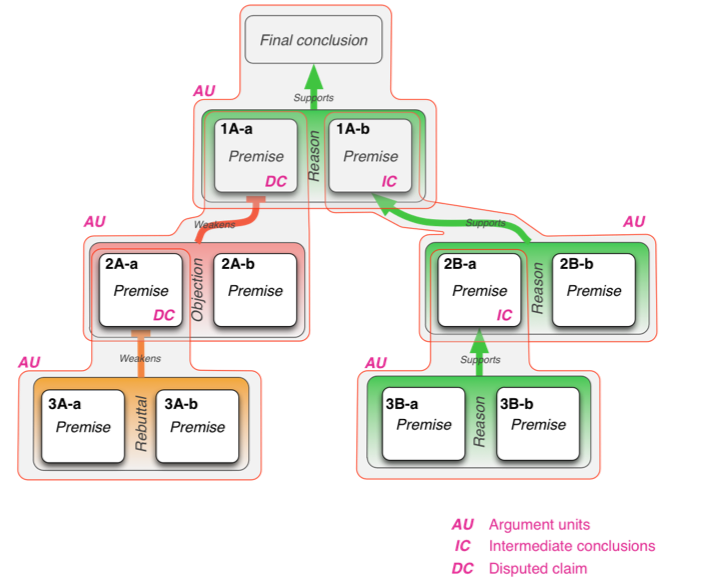 A complex argument showing ‘argument units’
Naturally, the argument advanced in a PhD will be complex with many different argument units. It helps to make these clear in argument maps. Doing so will make it easier to articulate your arguments in prose.
Argument mapping requires high-level skills, but the basic principles are simple enough. Follow these steps when mapping your argument:
- Be clear about your main contention. This is the claim that follows the introductory clause: “My thesis argues that…” This is a claim that sums up your unique and original contribution to the literature in your field. You may not be clear on this yet, especially if you are early in your candidature. However, you can begin with a tentative contention, and revise and refine it as your thesis progresses. This is common. As the thesis sharpens and becomes clearer, you will also need to refocus your contention, and the argument supporting it.
- Determine the first-tier reasons supporting your contention. Arguments can be complex, consisting of many argument units. It is likely that you will require many cascading tiers of reasons supporting a variety of intermediate conclusions. Try to concentrate on the levels within an argument. Thinking in terms of first, second and third-tiers (etc.) of reasons and localised argument units can help. Ask yourself: ‘Is reason X supporting this claim or this claim’? (Use inference indicator words to help you do this: ‘Am I claiming that X is true because of this, i.e., for this reason’?) Is there a clear link between the reason and the claim? Revise your argument until the logic of the connection between reasons and claims is transparent and clear.
- Next determine any first-tier objections to your contention. Follow the same process with reasons against claims as you did with reasons for claims.
- Then determine whether some of the objections can be rebutted. Can you think of claims that refute, or otherwise cast doubt, on objections? Follow the same process as you did for reasons and objections.
- Next determine second-tier reasons. How would you support the reasons you provide in the first tier of your argument? What reasons would support these reasons? Establish third-tier reasons/objections as required.
- Finally, establish any tacit co-premises that might be implicit in your argument, i.e., statements that are assumed but not often stated (making these clear that help you determine the originality of your argument, i.e., you might be casting doubt on an assumption in previous arguments in the literature).
When mapping your argument, strip all linguistic flourishes and academic jargon out. You are interested in getting the argument clear. Make all claims clear and precise and as short as possible - your argument can be “converted” into stylised academic prose later.
In the previous “rat” argument, the contention is clear (underlined):
Evidence from public health sources suggests that the public should be concerned about a rising rat population. First, the presence of rats shows that a rising rat population is an economic issue. They damage utility lines and wires, start fires and damage a lot of a city’s infrastructure in locations we can’t observe as indicated by damage to sewer walls or under sidewalks. Secondly, it’s a public health concern because rats roam the sewer systems and carry all kinds of germs. With a higher number of rats it can be assumed that our chance of coming into contact with those germs increases. Third, a rising rat population is an aesthetic issue. The presence of rats entails, and is a common indicator of, a degraded environment.
Paying attention to the inference indicator words (in bold), and the signposting language (in italics) we can display the tiers of reasoning along with tacit co-premises (tagged in yellow):
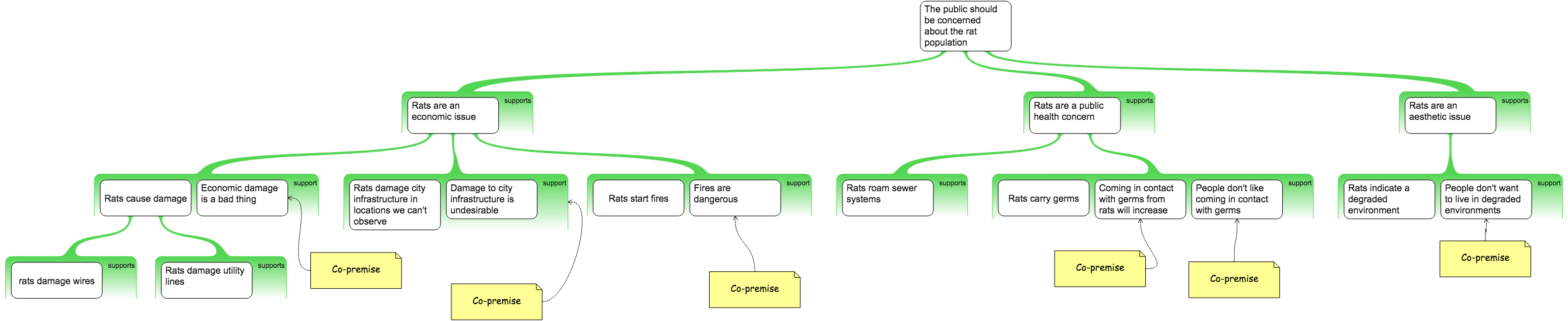 Complex argument with multiple tiers of reasons and co-premises
Now practise your understanding of argument mapping by mapping your own argument. Show your argument to colleagues and your supervisor. Ask them to focus on the links between the claims, reasons, objections and rebuttals. Ask them to consider the evidence provided. Revise your argument and then turn it into prose backed up with appropriate citations from the literature.
Argument mapping is an advanced-level skill. This page has only covered some basic principles. Further information can be obtained from the following readings.
Davies, M. (2019). New directions in teaching critical thinking. Change: Magazine for Higher Learning, 51(5), 18-27.
Davies, M., Barnett, A., van Gelder, T. (2021), Using computer-assisted argument mapping to teach reasoning to students, in Studies in Critical Thinking (A. Blair Ed) Windsor Studies in Argumentation (Vol. 8), 2nd Edition: Centre for Research in Reasoning, University of Windsor (L. A. Groarke and C. W. Tindale, Editors in Chief): Open Monograph Press.
Kirschner, P. J., Buckingham Shum, S. J., & Carr, C. S. (Eds.). (2003). Visualizing argumentation: Software tools for collaborative and educational sense-making. London: Springer-Verlag.
van Gelder, T. (2011). What is argument mapping? in H. Pashler (Ed.), Encyclopedia of the Mind. Thousand Oaks, CA. Sage https://timvangelder.com/2009/02/17/what-is-argument-mapping/