
Reports
Reports are one of the most common assessment tasks across disciplines. They have a distinct style, structure, and purpose. Unlike essays, reports are formal, focused, and written for a specific audience. Once you understand these differences, writing a report becomes much easier.
Differences between reports and essays
Essays are written in flowing paragraphs, each with a clear topic sentence. Sometimes they’re split into sections with headings, but that’s mostly to help guide the reader. Both essays and reports include an introduction, body, and conclusion. They both use evidence, in-text citations, and a reference list, and they stick to formal academic writing. But that’s where the similarities end.
Reports are always divided into sections (sometimes numbered), and each section has a specific job. Unlike essays, where everything flows together, reports are more like a toolkit: each part has its own purpose and place.
Here are some common sections you’ll see in a general report:
- Findings – What did you discover?
- Discussion (or Analysis) – What do those findings mean?
- Recommendations – What should happen next based on what you found?
Depending on the type of report, you might need more sections. The key is to make sure each section does its job, and that the right information goes in the right place.
Stylistically, reports are more flexible than essays. Bullet points? Go for it. Charts, tables, graphs, and other visuals? Absolutely. These tools help you present your ideas clearly and efficiently, something essays don’t usually allow.
Reports are also written with a specific audience in mind. That could be a company executive (business report), a group of scientific peers (empirical “scientific” report), or a professional in your field (like nursing, engineering or “Case study” reports). Even if it is just for your lecturer (lab report), you should write as though it’s for someone in the ‘real world’.
A business report, a psychology report, a nursing report, and an engineering report can look very different.
Psychology and engineering are both empirical or “scientific” reports (sometimes called AIMRaD reports after their main sections: Abstract, Introduction, Methods, Results and Discussion).
Business reports have a unique style of their own, and nursing reports tend to focus on case studies, therefore can be described as case study reports. What follows is broad advice about the structural elements of different report types, so check your course description or ask your lecturer for guidelines if you need specific instructions.
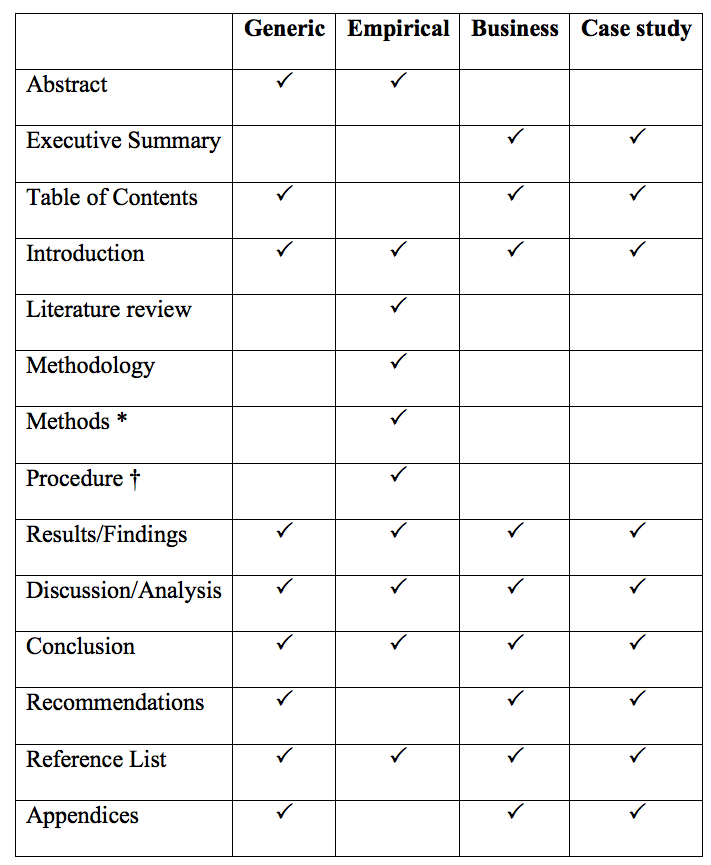
Note: Methodology is the conceptual and epistemic justification of how one arrived at one’s results, the Method* is the type of research tool used, and the Procedure † are the steps taken in carrying out the study itself. In some reports, ‘Method’ and ‘Procedure’ are conflated and subsumed under ‘Methodology’. They are often separated typically when an experiment is complex with multiple variables.
A report outlines research that has been carried out (be it observational or conducted in a lab), or it presents information to inform a decision, or to account for specific actions. What kind of report you are writing will influence the components you include.
You may, for example, be asked to write a cover letter for a business report to the intended audience, such as an imagined CEO. In a nursing report, you may be required to describe or respond to a real or imagined real-life situation, a ‘case’, to inform decision-making in an area of nursing practice.
Direct your considerations to the intended audience and make the aim of the report clear, using a narrowly-focused aim statement.
For example:
-
- 'This report provides an account of the rise in eCommerce profitability in the US sanitary products industry from 1984 to 2020.'
- 'This report aims to investigate the reasons behind crustacean habitat destruction in the Port Phillip Bay area.'
The aim statement is critical: It directly responds to the needs of your intended audience. This is why reports are written. In a company or a large organisation, e.g., the CSIRO or the public service, a report will often be requested – they almost never ask for an ‘essay’.
Later sections of the report tie back to the aim statement:
- Method: explores and articulates how you will address the aim statement.
- Results: what was found about the aim statement.
- Discussion: analyses the results in response to the aim statement.
- Recommendations: outlines what should be done in response to the results in relation to your aim statement (business and case study reports only).
Sections in a report
The following information outlines what is commonly included in most reports. Please check your unit requirements before applying these guidelines. We do not include a literature review here, which is common in some reports (empirical reports), but not in others (business or case study reports). If a literature review is included in a report, it goes after the introduction and before the method section.
A table of contents helps the reader locate information quickly. The table of contents also provides an overview of the structure of the report. The contents pages should be separated from the rest of the report and include all headings and subheadings. These should be:
- written exactly as they appear in the report
- numbered exactly as they appear in the report
- with their page numbers
You can create a table of contents with Microsoft Word using the 'Table of Contents' function in the 'References' tab.
A list of abbreviations can also be given in the table of contents if the report is lengthy and many abbreviations have been used.
List of figures
A list of figures is used mainly for reports containing numerous figures. It includes the figure number, caption and page number, ordered as they appear in the text.
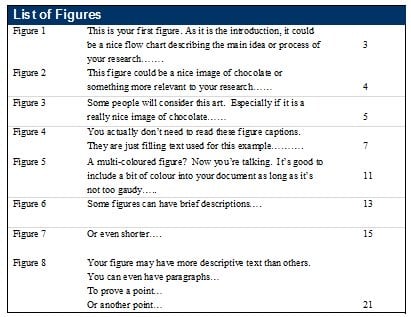
Image: Example - List of Figures. (Adapted from: luckylion.de/vasco/tutorials/indesign_beyond_the_thesis/a_pictures/list_figure_example.png)
List of tables
This list is used mainly for reports containing numerous tables. It includes the table number, caption and page number, ordered as they appear in the text.
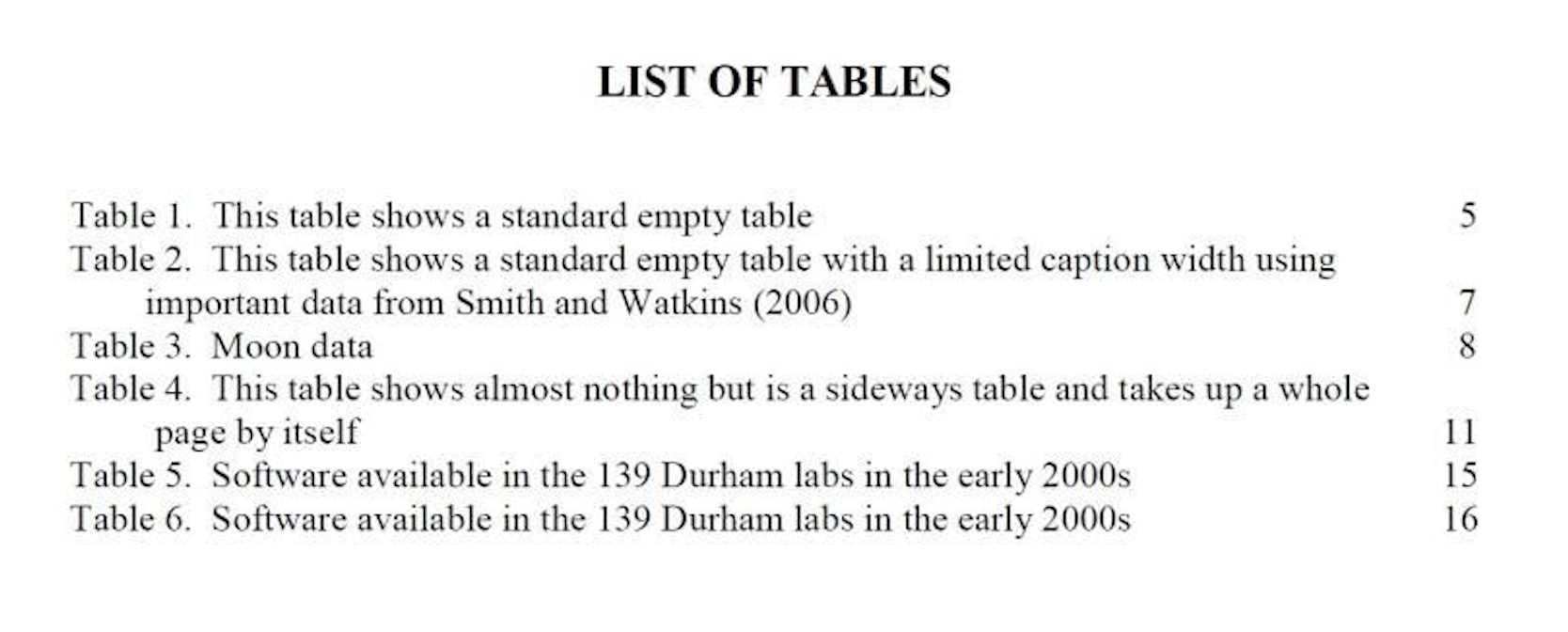
Image: Example - List of Tables (Source: http://i644.photobucket.com/albums/uu164/thinktank1985/Untitled-1.jpg)
The abstract is a short summary of all the main sections of a report from the introduction through to, and including, the recommendations (if applicable). It should be independent (can be read on its own); comprehensive (covers all the main points); clear and concise. Generally, it should be short, only 5-10% of the length of the report/essay, and written in full sentences. Write the abstract after you have written the entire report as it is only then you are clear on what your report achieves and the limitations that it might have.
The abstract is normally placed before the table of contents, on a separate page. The introduction follows the table of contents.
It is easy to confuse the structure and purpose of an abstract with that of an introduction. Note the differences below…
| Abstract | Introduction |
|
|
The abstract is a summary of all the contents of the report, including the conclusion and recommendations. It is usually written using the tense appropriate to each of the sections in the report that it is summarising. The introduction, on the other hand, provides a background or context to the purpose of the report, narrows down to the aim statement, and tells the reader what is going to be discussed in the body. It uses the present tense. In advanced report writing, an introduction also includes identification of a research gap that the report hopes to fill.
An executive summary is common for business reports. This is like an abstract in that they both summarise the report but there are some key differences. They are longer than an abstract; may include bullet points; and often address recommendations in some depth (these are never included in scientific reports). They comprise as much as 20% of the report.
The method section is specific to scientific research reports and is one of the easier parts to write in a report. In this section, you need to outline how your research was conducted. Depending on whether you’re writing a psychology report or a scientific lab report, it can be written in prose form, or sometimes using dot points (especially in business reports). The types of questions you need to answer in your method section also depend on the discipline.
Sample questions to answer in your method
| Discipline area | Types of questions to answer |
| Scientific lab report |
|
| Psychology report |
|
Example: Method section of a biology report (excerpt)
'Growth rates were determined by estimating the number of bacteria in a culture at zero time and after 1 hour of growth at 37°C. To make this estimation, a dilution series was performed by diluting aliquots of the bacterial culture, at each incubation time, by a factor of 10, 100, and 10 000 with nutrient broth, and then plating out 0.01ml of each of these dilutions onto quadrants of a sterile agar plate. Following one week’s incubation at 25°C, the colonies of the plate were counted manually.'
Note: Enough detail is provided for someone wishing to repeat the experiment. No commentary is provided on the method. It is a series of factual descriptions.
(Unilearning, 2000)
If anybody were to read your method, they should be able to recreate your research exactly. Ask yourself whether that would be possible, based on your account of the method. If the answer is ‘no’, then you may have left something out. Your purpose is not to comment on the method, or analyse it, you’re simply describing how it was done.
This section is more specific to scientific research reports. It discusses the results of the research but does not analyse them. There might be a brief comment or two on the results pointing out how there was an unexpected rise in data obtained, for example, but that’s about all. Detailed analysis is left for the discussion section. The results section can be a brief section where you simply write what you found in your experiment. Point out any trends but don’t analyse them. This section should be written in full sentences but can also include tables or figures if you are instructed to do so. Read this for more about presenting data.
Example: Results of a chemistry report (excerpt)
'When samples of hydrolysed and unhydrolysed BSA were analysed by ascending paper chromatography, the appearance and separation of the two samples were quite different. The unhydrolysed BSA had very little colour and appeared to remain on the origin (Fig. 1). In its hydrolysed form, however, the BSA sample separated into a few spots which were bright pink or purple (Fig. 1).'
(Unilearning, 2000)
Note: Description, with comment but no analysis. Notice the reference to figures showing the results themselves.
The discussion is one of the larger sections of a report and includes an analysis of your results and an outline of their significance in relation to the literature in the field. You need to:
- explain and interpret your results
- assess whether the questions you raised in your introduction have been answered
- refer back to any theory or research your referred to in your introduction and/or literature review (if applicable)
- identify any areas of significance in your results in the context of the various competing theories that are relevant.
Do your findings contradict the findings of previous research? This needs to be mentioned in the discussion.
You also need to mention any limitations of your research in this section. Limitations are any problems with your method that could have been improved upon or that might have affected the results in some way. Perhaps your sample size wasn’t large enough, or an item was contaminated. Be sure to mention that here. Despite it being called the ‘discussion’, it should still be written objectively.
A reference list should be attached to every report. It starts on a new page after the conclusion and before the appendices (if applicable). It consists of full citation details of every work cited in the report in the relevant referencing style. Most referencing styles have their own guidelines for writing a reference list, so refer to our online referencing tool, FedCite, for more information.
Appendices (appendix if singular) are more common in reports than in essays and they appear at the very end (after reference list). Your lecturer will tell you if appendices are required. They are particularly common in business reports and case study reports, and almost unknown in scientific reports.
Appendices are typically made up of items used in your report for readers to refer to for more detailed information that could not be included in the body of the report for reasons of space, or which would be out of place in the report itself as they are tangential (i.e., useful but not essential). They may nonetheless be useful in guiding others wishing to conduct the research themselves. They may also be useful readers who want further details on areas mentioned in the report but not dealt with in detail.
Appendices are signalled in the text of the report in brackets (e.g., see Appendix A). This is the equivalent of saying: “I’ve got more information on this at the end of my report so have a look there”.
For example, if you used a questionnaire that you discuss in your report, you might attach a copy of the questionnaire as an appendix but refer to it by saying, "The consumers were surveyed and the results lead to our decision to…. (for survey details, see Appendix D)". The letters of each appendix are in the order they are mentioned in the report, A is first, then B, then C and so on.
List your appendices at the front of your report in the table of contents, or as a separate list. Each appendix should be lettered, i.e. Appendix A, Appendix B, etc.), its title and page number, ordered as they appear at the end of the report.
For example:
Appendix A: Data on pancake consumption … p. 8
Appendix B: Histograms on pancake consumption … p. 9
Appendix C: Geographical location of pancake consumers … p. 10
Appendix D: Survey for consumers … p. 12
Business reports
The purpose of writing reports in business disciplines is to prepare students for the workplace where most forms of information are communicated in some form of a report. This is particularly the case in commercial contexts or workplaces within the public service.
Depending on the aim of the report (and specific business discipline area), it can require presentation of information only (financial statements for commerce and accounting); information with interpretation (product analysis for marketing); or information with analysis and recommendations (management and other areas).
| Essay | Report | |
| Purpose | Expresses a point of view and presents a thesis statement. | Has an aim statement. Often recommends an action to solve a specific problem. |
| Format and structure |
Has introduction, body and conclusion sections that normally do not use headings. Uses cohesive paragraphs to link ideas. |
Has introduction, body and conclusion sections. Body sections are divided into sub-sections. Headings are used extensively. Uses shorter, more concise paragraphs and frequent bullet points where applicable. |
| Abstract | Abstracts are not normally needed as readers read the text carefully from start to finish. | Always has an abstract (or Executive Summary) as readers are typically ‘time poor’ and skim and scan through the text quickly. |
| Graphics | Rarely uses graphics (such as tables and graphs) as written evidence. | Extensive use of tables, charts and other graphics for supporting main points. |
| Writer | Generally the result of individual work | Often the result of group work. |
(Adapted from the University of Sydney, n.d.)
| Section | Inclusions |
| Front Matter |
|
| Body of the Report |
|
| Back Matter |
|
An executive summary is mainly expected as part of a business report. Although it is like an abstract in that they both summarise a paper and have a similar framework (see above), there are key differences.
An executive summary:
- is written as a stand-alone document and can be quite long – up to 15-20% of the word-length of the report
- starts with the key findings of the research, which are then expanded upon
- often uses dot points for emphasis and to keep it short
- has a strong focus on the recommendations and their justification, and
- must accurately reflect what is in the report (the recommendations are sometimes word-for-word from the report).
How to write an executive summary
Inform the reader of the objective, or purpose, of the report. For a health benefits report model, this paragraph might explain how the report demonstrates that a change in the organisation’s employee health plans would be beneficial to the organisation, and how the goal of the report is to support a change in the organisation’s benefits policy.
Then you might outline the benefits of the plan or course of action that you recommend. A bulleted list can be an effective way to state the benefits concisely. Since an executive summary will not contain extensive data or details (these will be in the report itself), this is an excellent way to summarise data in the report. Nonetheless, the benefits of the action recommended are comprehensive.
For example:
'The organisation should consider a change in employee health plans for the following reasons:
-
- The organisation is currently spending an average of 32% of its annual earnings on benefits.
- The current health insurance is unsatisfactory according to the employees, since the current provider has raised deductibles and reduced benefits.
- A change to plan ABC from company XYZ would increase both profitability and employee satisfaction.
- Better health benefits will also improve the company’s ability to recruit and hire talented job candidates.'
Finally, conclude the executive summary with specific recommendations, for example:
'The organisation needs to switch to company XYZ’s health package at the beginning of the next fiscal year, since this will increase profitability and employee satisfaction.'
An executive summary, unlike an abstract, is often the only thing read in a report so it must encapsulate the significant parts of the report itself.
(Adapted from University of Maryland University College, 2014)
The content of an business report Introduction is similar to an essay introduction as it moves from general to specific information. Write this part after you have written the body of the report.
Answer questions like “What is this report about?” and “How is it useful?” and include:
- brief background information
- a description of the overall purpose, aim, and key objectives
- an overview of the issues that you will discuss (scope)
- an outline of any limitations to the report, or assumptions.
Business reports can have both an introduction and an executive summary - check with your lecturer to establish if you need just one or both sections in your report.
Scientific reports
The purpose of scientific reports is to communicate results from your technical or scientific experiments to an audience of scientific peers. It also outlines the state of a technical or scientific research problem. Scientific reports are normally published in relevant discipline-area journals. Students are being trained to write scientific reports in a like-manner, though of course the audience is the lecturer and the purpose is assessment.
Typically, scientific reports follow the AIMRaD structure strictly (Abstract, Introduction, Method, Results and Discussion). Sometimes they are called ‘research/scholarly reports’ or ‘research papers’ or ‘empirical reports’.
General structure
Scientific reports are usually written in science, engineering, IT, and psychology disciplines and require you to outline and analyse specific research you have conducted. But, as you will see in examples further on, the structure can vary according to the field of study.
| Individual sections | Content of each section |
| Title of Report | Concise heading indicating what the report is about. This is normally highly descriptive and compressed to indicate exactly what the research study involves. |
| Table of Contents (typically only for reports for industry) | A list of what is covered in the report. |
| Abstract/Synopsis | Concise summary of main findings. |
| Introduction | Why the research is needed, the “gap” in knowledge, and the hypothesis or research statement. |
| Literature Review (sometimes included in the Introduction) | An overview of other relevant research in this area. |
| Methodology | What you did and how you did it. |
| Results | What you found. |
| Discussion | Significance of what you found, i.e., your results; how it fits with other research in the area. Implications of results for previous published work and further research that might be conducted. |
| Conclusion | Summary of results/findings and suggestions for further research. |
| Recommendations (sometimes included in the Conclusion) |
What needs to be done as a result of your findings. Note: Quite rare in published scientific reports but may be seen in scientific reports in industry and scientific organisations. |
| References or Bibliography | All references used in your report or referred to for background information. |
(Adapted from University of Adelaide, 2008)
Engineering reports usually follow a technical report structure that has the same front and back matter as a scientific report, but the body contains an introduction, middle sections with headings, and a conclusion. Regardless, always check with your lecturer to ensure you use the preferred report structure.
Write your introduction after you have written your method and results sections, as by then you will know exactly what your body section is about, and your writing will be more precise and confident.
The Introduction can include:
- the background to the topic of your report
- a clear statement of the purpose of the report
- technical background necessary to understand the report, e.g. theory or assumptions
- Gap or need in research that the study tries to fill
- a clear statement of the aims of the specific project (can be expressed as an hypothesis or research question)
- a brief outline of the structure of the report if appropriate.
Example: Engineering technical report introduction
Using the above colour code:
A dual carriageway bridge with two traffic lanes in each direction is to be constructed on the Calder Freeway crossing Slaty Creek in the Shire of Macedon Ranges in Victoria. The bridge is to span 125 metres between man-made compacted fill embankments, and is approximately 15 metres above the river surface, with a grade of 0.056 m/m. This report presents two possible concept designs for the bridge. In evaluating these designs, the following criteria are considered: construction method, construction and maintenance costs, possible disruption to traffic during construction, the durability and the aesthetics of the bridge. The two conceptual designs are presented in the form of sketches of the elevations and cross-sections of the structures.
(Monash University, 2014)
This section discusses the results of the research, and may offer a brief comment about the results, but does not analyse them. The analysis is done in the discussion section. The results section can be a brief section where you simply write what the outcome of the experiment was. This section should be written in full sentences but can also include tables or figures if you are instructed to do so.
Example: Results of a chemistry report (excerpt)
'When samples of hydrolysed and unhydrolysed BSA were analysed by ascending paper chromatography, the appearance and separation of the two samples were quite different. The unhydrolysed BSA had very little colour and appeared to remain on the origin (see Fig. 1). In its hydrolysed form, however, the BSA sample separated into a number of spots which were bright pink or purple (see Fig. 2).'
(Unilearning, 2000)
Note: Description and brief comment but no analysis.
Also referred to as the body, this is one the larger sections of any report. For more detailed information on the Discussion segment of a report, see the Sections in a report - Discussion or Analysis section above.
Example: Excerpt of a discussion from a chemistry report
The activity of the salivary amylase enzyme in this experiment increased with temperature up to 37°C. This was probably an effect on the reaction itself, as the rate of chemical reactions generally increases as temperature increases because there is more energy in the system at higher temperatures (Stryer, 1995, p. 46). Most enzymes are denatured at temperatures above 50°C (Perkins, 1964); however, in this experiment, the activity of the amylase was highest at 70°C. This may be explained by the variation in temperature that is experienced in the mouth during eating, which may require a high degree of heat-resistance in the amylase enzyme …
Explanation
- State the major results again
- Interpretation/explanation based on what is known (cite references)
- An unexpected result
- Attempt to explain how/why the result occurred