
Essays
Strong essays are built with structure, purpose, and evidence. They're your chance to craft a clear, confident argument that makes an impact. Learn how to plan, write, and polish your ideas step-by-step.
Essays are a big part of uni life. You'll write them for almost every subject throughout your degree. They'll start short and simple, but over time they'll get longer and more sophisticated.
Academics write them too, for conferences, presentations, and publishing research (they call them 'papers').
This page walks you through:
- What essays are for
- How to plan and structure them
- What each section needs and how to write it well.
Read on for practical advice to shape your ideas into clear, confident writing that gets your message across.
Essays are different across disciplines
Each discipline has its own stylistic preferences and genre conventions when it comes to academic writing. An essay for biology will be very different from an essay for visual arts or philosophy. Economics essays are different from essays in marketing. Some essays require an empirical (scientific) methodology; others require theoretical analysis and critical interpretation of text; others require personal reflective analysis; others are different again.
Listen carefully to your lecturer when they tell you what they are looking for in an essay. Be sure to read the assessment task fully and do a topic analysis.
Fortunately, the ‘essay’ as a writing genre has universal elements too: those of structure and academic writing style. Crafting an essay involves learning many transferable skills, including how to:
- develop a succinct, clear, scholarly writing style
- defend a point of view with evidence
- construct an academic argument
- marshal sources, cite and reference
- use established conventions that are applicable in all professional-level writing.
These skills are all useful in the workforce. The ability to write in a professional way is relevant to all areas of employment. It is therefore wise to take the process of learning to write essays seriously.
This is a general guide, and not specific to your discipline. Should you have any specific questions about the structure of your essay, ask your tutor or lecturer.
Different types of essays
In general, your main goal in an essay is to present information about a topic along with your point of view on it. There are two main forms of essay, argumentative or reflective.
Argumentative
Argumentative essays analyse or interpret an event, problem, situation, or theory; and they argue a point of view about that event/problem/situation/theory; and they provide evidence to support the argument.
Reflective
Reflective essays typically either 1) describe a situation and present a point of view about an issue of concern that you have experienced; or 2) evaluate a situation that you might experience as a professional and draw conclusions about how to deal with it.
Occasionally you may be asked to write descriptively and reflectively. This occurs in subjects like nursing and allied health professions subjects, in psychology or community welfare disciplines. Usually, however, you are expected to analyse, discuss or evaluate an issue, applying research to support an argument.
Either way, your essay should always have one major aim, which defends your point of view.
Planning and structure
Having a plan before you start writing will provide direction. It will allow you to map the topic and align your research with each paragraph. Read about the planning process in detail.
Structuring simplifies the process of writing. It may help to think of structure as the skeleton of your writing - if your body was missing a skeleton, you’d flop around. Essays without structure do much the same.
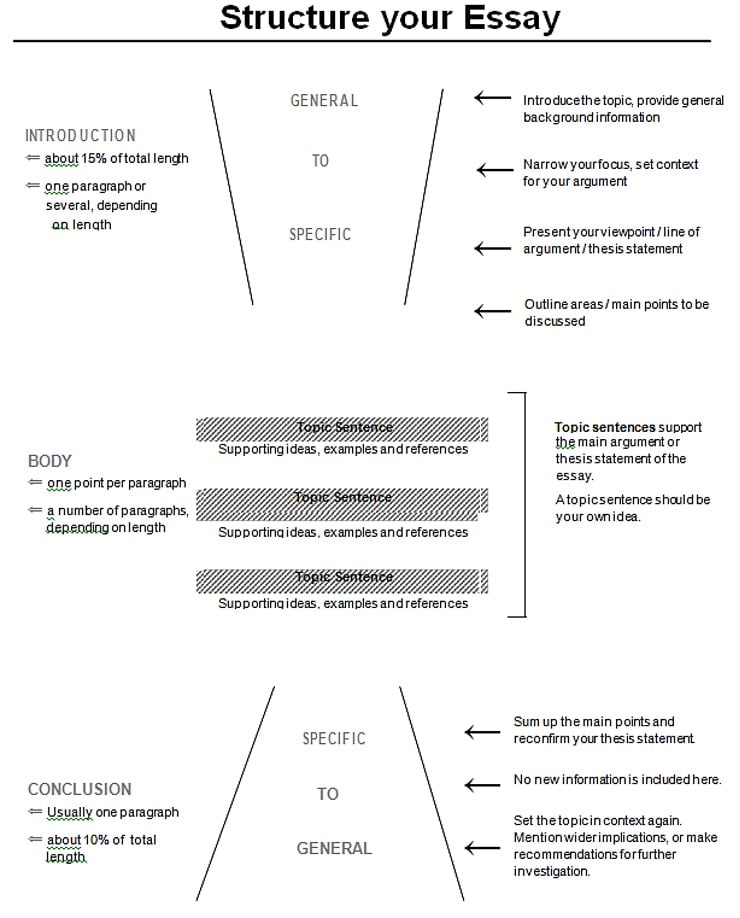
There are three main parts of an essay: the introduction, the body and the conclusion. One simple and memorable way to describe each part is as follows:
- Introduction: tell them what you’re going to say
- Body: say it
- Conclusion: remind them what you just said
That’s oversimplifying it, but it’s a quick way to remember the purpose of each section. Take a look at this visual outline of essay structure:
Introductions
Introduce the topic, provide general background information: Show the context of your essay by introducing some key words or concepts from the topic. This can be done in a sentence or two.
Example: Essay topic
"Discuss the impacts of the phenomenon of performance enhancing drugs in Australian professional sports on adolescent athletes".
The first sentence of an example Introduction may go something like this:
Performance enhancing drugs have been shown to have a detrimental effect in the Australian sporting world since the 1980s as evidenced in the media and among professional sporting bodies (Fenanigan & Crawley, 2013).
In this example, three key words have been introduced: 'performance enhancing drugs', 'Australian' and 'professional sports'. Your next sentences can expand on this information.
Narrow your focus, set the context for your specific argument: Introduce the other key words from your topic to set up the context for your point of view, or thesis statement.
You may want to define certain words at this point as well, for example:
Young adolescent athletes, generally aged between 14 and 18, are not immune to the prevalence of drug use. This is not only based on their awareness of its existence in professional sports, but their own attitudes towards performance enhancing drugs (Hagan, 2013).
Other key words from the original topic were introduced here, namely, 'adolescent athletes'. This sets the scene for the essay and leads the reader towards your specific angle on this subject. Your essay will focus on adolescent athletes and the issue of drug-taking in sport.
Present your viewpoint/line of argument/thesis statement: Next you state the main argument or focus for the Body of your essay based on the background information you provided for the reader. This can either be a direct answer in response to the essay topic, or a statement about the issue highlighted in your essay topic.
Ensure all key words from the essay topic have been introduced by this stage, so that your reader has the complete context for your ideas.
For example, a thesis statement that outlines the issue to be discussed in your essay could be something like this (using the topic of drug-taking in sport):
Drug taking in sport has only negative impacts on adolescent athletes with regard to their own potential moral code as professional sportspeople and also their propensity for participating in drug taking itself.
The underlined part is the thesis statement you will defend in the Body of the essay.
Alternatively, your argument can be a direct answer to a question posed in the essay topic. Suppose your essay topic is: "Why are nurses more susceptible to chain smoking compared to other professionals?"
In response you can write something like this:
This essay argues that nurses are more susceptible to chain smoking than other professionals because of their excessive and stressful work demands and their poor work-life balance.
The underlined part is the thesis statement you will defend in the Body of your essay.
Students writing on the same essay topic will typically have a different thesis statement in response to the essay topic. This is because of the evidence they adduce and how they interpret the essay question or topic.
Outline areas/main points to be discussed: The job of this part of the Introduction is to inform your reader about what is coming next. The next part of the essay is the body. This part of the introduction is a courtesy to your reader. It gives them the confidence that you are not going to ramble. You need to state what the main points in the body paragraphs will be about. For example:
This essay examines impacts on the attitudes and aspirations of young athletes as a result of drug use in sport, and how these arise because of role modelling and exposure to drugs through sports clubs.
This tells the reader the body of your essay will cover:
- impacts of drug use on attitudes of young athletes
- impacts of drug use on the aspirations of young athletes
- how the impacts arise as a result of role modelling
- how the impacts arise from exposure to drugs in sports clubs.
You will notice that the final section of the introduction is tightly written and succinct. It uses as few words as possible to get the message across and avoid repetition.
It should be noted that the four sections described above do not have to be followed in this rigid order. Use them as needed in your essays but always follow your marker’s instructions in the first instance.
Importantly, when writing the body of the essay, make sure you do what the introduction says you are going to do!
Generally, your introduction makes up approximately 10-15% of your total length. So, if you were asked to write a 2,000-word essay, your introduction would be about 200–300 words, as a general estimate.
Topic
Analyse the role of the MCH nurse working in partnership with the family to care for a child with a diagnosed developmental delay.
Format of example
This example includes background information, narrowing focus, a thesis statement, and an outline of the main ideas. You’ll find the name of the section in [brackets] followed by the sentence that corresponds.
Example with section labels
[Background information] Monitoring the growth and development of children at regular intervals allows for the early detection of developmental delay. One of the key aims of Maternal and Child Health (MCH) nursing practice is the early detection and the referral of children with a developmental delay (Neil & Marcuson, 2011) [end background information]. [Narrowing focus] In the transition from suspicion and concerns about their child’s development, to the confirmation of the diagnosis of developmental delay, the lived experience for the family takes on a whole new chapter. Depending on the degree of severity and permanence of the developmental delay, families may face a rollercoaster journey of therapies, testing and appointments (Collster, 2009). Families may also face the loss of the sense of normality of their child eventually growing into an independent adult, as well as mounting financial burdens (Foster & McCauley, 2010) [end narrowing focus]. [Thesis statement] MCH nursing practice has a role to play in supporting families beyond the diagnosis, especially in the context of more major persistent delay where there is significant impact on the family [end thesis statement]. [Outline of the main ideas] In the context of the impact on the family, this essay explores the question of what happens following a diagnosis of developmental delay and how MCH nurses can work collaboratively with families. Developmental delay is discussed generally rather than with reference to a specific type of delay, and the role of the MCH nurse (MCHN) in the care of the child is critically analysed along the spectrum of working in an expert role to working in partnership with the family [End outline of the main ideas].
Example as used in an essay
Monitoring the growth and development of children at regular intervals allows for the early detection of developmental delay. One of the key aims of Maternal and Child Health (MCH) nursing practice is the early detection and the referral of children with a developmental delay (Neil & Marcuson, 2011). In the transition from suspicion and concerns about their child’s development, to the confirmation of the diagnosis of developmental delay, the lived experience for the family takes on a whole new chapter. Depending on the degree of severity and permanence of the developmental delay, families may face a rollercoaster journey of therapies, testing and appointments (Collster, 2009). Families may also face the loss of the sense of normality of their child eventually growing into an independent adult, as well as mounting financial burdens (Foster & McCauley, 2010). MCH nursing practice has a role to play in supporting families beyond the diagnosis, especially in the context of more major persistent delay where there is significant impact on the family. In the context of the impact on the family, this essay explores the question of what happens following a diagnosis of developmental delay and how MCH nurses can work collaboratively with families. Developmental delay is discussed generally rather than with reference to a specific type of delay, and the role of the MCH nurse (MCHN) in the care of the child is critically analysed along the spectrum of working in an expert role to working in partnership with the family.
(adapted from LaTrobe University, 2014)
Body paragraphs
The body consists of a series of paragraphs, and each paragraph should cover only one topic. A key to writing effectively in the body of your essay is to include topic sentences.
The topic sentence tells the reader what the paragraph is about and is written in your own words. Using the original essay topic on sports, drugs and adolescents, you might start your first body paragraph with:
Inevitably, being a professional athlete in Australia means there is the additional responsibility of becoming a role model or the 'face' of a sport for younger generations.
There should be no need to reference this sentence as it is supposed to be your idea that you have developed based on your own research. Following this topic sentence would be evidence (examples and references) for your statement that explores and justifies why this is the case.
Notice the extensive use of linking words in [brackets] in this example. They act as signposts in the essay which are invaluable for your reader as they help ensure clarity of expression. Linking expressions should be used throughout your essay.
Example with section labels
[Topic sentence] The diagnosis of developmental delay can result in a wide range of reactions from family members [end topic sentence]. [Evidence] Head and Abbeduto (2007, p. 293) [end evidence] note that some families have high levels of stress with sustained impairment of functioning, while some thrive on the challenges associated with the child’s developmental delay. [Linking words] But [end linking words], the impact of having a child with a developmental delay on a family can never be underestimated. There are often very intense emotions such as grief, anger, disbelief and isolation [Evidence] (DCDR, 2008, p. 13) [end evidence]. [Linking words] In particular [end linking words], the time of diagnosis can be a crisis where the parents’ expectations are turned upside down [Evidence] (Sen & Yurtsever, 2006, p. 239) [end evidence]. Because the child is most influenced by their family, it is very important to empower the family [Evidence] (Blann, 2005, p. 265) [end evidence] and so the nature of the relationship between families and health professionals is important. [Linking words] Specifically [end linking words], how the family is treated at the time of their child’s initial diagnosis can have long term impacts [Evidence] (DEECD, 2010a, p. 27) [end evidence]. [Linking words] Therefore [end linking words], it is important that the MCH nurse leaves room for hope at this initial stage, as this leads to a family’s healthy functioning within a framework of optimism [Evidence] (Kearney & Griffin, 2001, p. 589) [end evidence] and helps build a connection between the MCH nurse and the family.
Example as used in an essay
The diagnosis of developmental delay can result in a wide range of reactions from family members. Head and Abbeduto (2007, p. 293) note that some families have high levels of stress with sustained impairment of functioning, while some thrive on the challenges associated with the child’s developmental delay. But, the impact of having a child with a developmental delay on a family can never be underestimated. There are often very intense emotions such as grief, anger, disbelief and isolation (DCDR, 2008, p. 13). In particular, the time of diagnosis can be a crisis where the parents’ expectations are turned upside down (Sen & Yurtsever, 2006, p. 239). Because the child is most influenced by their family, it is very important to empower the family (Blann, 2005, p. 265) and so the nature of the relationship between families and health professionals is important. Specifically, how the family is treated at the time of their child’s initial diagnosis can have long term impacts (DEECD, 2010a, p. 27). Therefore, it is important that the MCH nurse leaves room for hope at this initial stage, as this leads to a family’s healthy functioning within a framework of optimism (Kearney & Griffin, 2001, p. 589) and helps build a connection between the MCH nurse and the family.
(adapted from LaTrobe University, 2014)
Conclusion
The conclusion is where you wrap it all up. It’s much like the reverse of the introduction in that you remind your reader what the focus of your essay was. This includes your thesis statement, and an outline of your arguments from the body. You then close with a general statement such as any recommendations about further research that could be done (if that’s appropriate), or a general summary sentence. There should be no new information in the conclusion or any references. If a point is important, it should be in the Body. The conclusion is your own summary of your essay and what it has achieved.
Format of example
This example includes the reminder of thesis statement, re-statements of main points, and the concluding statement. You’ll find the name of the section in [brackets] followed by the sentence that corresponds.
Example with section labels
[Reminder of thesis statement] The role of the MCHN has been critically analysed in the context of the question of “What happens afterwards?” for families once their child has a diagnosed developmental delay [end reminder of thesis statement]. [Re-statement of main points] The appropriateness of MCHN involvement has been questioned [end re-statement of main points] particularly from the view of not wanting to place a greater burden on a family who may already have multiple practitioners involved in their care, and a time consuming schedule of appointments. It is acknowledged that in some circumstances particularly where there are complex needs, [Re-statement of main points] it may be in the families’ best interests to not have MCHN involvement [end re-statement of main points]. However, [Re-statement of main points] the MCHN’s availability could be invaluable for families who require support if issues arise… [end re-statement of main points] For families who do have ongoing contact with the MCHN service, [Re-statement of main points] the role of the MCHN may involve assisting parents with their child’s basic needs of attachment, feeding, sleep and behaviour, and normalising behaviour which is not part of the delay… [end re-statement of main points] As the need arises, [Re-statement of main points] the MCHN can offer information and referral to support services [end re-statement of main points], and as a free service [Re-statement of main points] the MCHN does not add to the financial burden on the family [end re-statement of main points]. [Concluding statement] When they need to share and be heard, the MCHN may be the only person that mothers and families can go to, and as such, this is a vital role in the health and wellbeing of the family [end concluding statement].
Example as used in an essay
The role of the MCHN has been critically analysed in the context of the question of “What happens afterwards?” for families once their child has a diagnosed developmental delay. The appropriateness of MCHN involvement has been questioned particularly from the view of not wanting to place a greater burden on a family who may already have multiple practitioners involved in their care, and a time consuming schedule of appointments. It is acknowledged that in some circumstances particularly where there are complex needs, it may be in the families’ best interests to not have MCHN involvement. However, the MCHN’s availability could be invaluable for families who require support if issues arise… For families who do have ongoing contact with the MCHN service, the role of the MCHN may involve assisting parents with their child’s basic needs of attachment, feeding, sleep and behaviour, and normalising behaviour which is not part of the delay… As the need arises, the MCHN can offer information and referral to support services, and as a free service the MCHN does not add to the financial burden on the family. When they need to share and be heard, the MCHN may be the only person that mothers and families can go to, and as such, this is a vital role in the health and wellbeing of the family.
(Adapted from LaTrobe University, 2014)