
Literature reviews for undergraduates
A literature review is like a guided tour through what other researchers have said about a topic. It helps you evaluate, classify, and present existing ideas so you can build your own. Want to know how to structure one? Let’s walk through it.
A literature review helps you present, classify and evaluate what other researchers have written about a topic. It’s not just a 'shopping list' of sources, it’s a structured overview shaped by your research objective, research question, and/or the problem/issue you’re exploring.
With a clear focus, your review becomes a roadmap of what’s already been done in the area you’re investigating.
Why do a literature review
Surveying and evaluating the literature that has already been written on a subject provides context for your own research. It enables you to clarify and sharpen your own research focus and methodology. Evaluating each publication by reviewing it can also clarify what has been established with a degree of certainty, and what is considered acceptable research work in a given field of study.
What is literature
Literature refers to all the texts and works concerning a particular topic. If you’ve been asked to do a literature review on the history of the Aztecs, the literature refers to any books, journals, conference papers, letters or documents or other pieces work about (or by) the Aztecs. Literature is generally divided into primary, secondary and tertiary sources.
Literature sources
A primary source about the Aztecs would be a first-hand report of an encounter with them, or any work by an Aztec. Primary sources are always considered the strongest means of evidence. In the university context, a primary source is also a seminal paper by an author that outlines for the first time a key concept, theory or methodology that is later used by other researchers. It’s the first time something important is published.
Secondary sources evaluate or discuss primary sources. A secondary source is based on the work of another person and is usually an analysis of the original source. It’s important to not take any single secondary source as a complete representation as they might be unsubtle, misinformed, or wrong.
Secondary sources can be valuable in terms of determining the degree of influence of primary source material, but when using secondary sources read widely and read critically.
Tertiary sources collate a broad array of information on a topic and compiles it in one location. A text book, for example, is a tertiary source, as it takes a lot of information within a field and presents it conveniently in one document.
Tertiary sources can be useful in working out the ‘lay of the land’ in terms of a field of study. It’s good to start out with tertiary sources, but quickly drill down to primary and secondary sources when you are clear about the focus of your research.
Decide how many references to use
The number of sources you need depends on your level of study and the topic itself. A 'hot' topic in an area of cancer research for a PhD student might require keeping abreast of hundreds of research publications a week. A 'cold' topic such as St Anselm’s third version of the ontological argument for God’s existence, might have a very limited range of research publications worldwide, and no recent publications.
As a general guide (check with your lecturer):
- Undergraduate review: 5-20 titles depending on level
- Honours dissertation: 20+ titles
- Masters thesis: 40+ titles
- Doctoral thesis: 50+ titles
Know what your aim is
If you are writing a thesis or dissertation, the aim of writing a literature review is to understand the context of your own research by surveying and evaluating what has already been written on the topic. Surveying the literature can enable you to clarify your own focus and methodology. Evaluating each publication can also clarify what are considered valid and important areas in your field of study.
Crucially, a literature review helps to establish the research gaps in a particular area and, in so doing, outlines areas that require further research and investigation. When reviewing literature, you refer to what others have written or done on a topic and compare and contrast the work of others. Your aim is to find a gap: i.e., what others have done and what needs to be done in your particular area of study. The literature review puts this gap into focus. Filling the gap is what you then go on and do in your research.
Narrow your focus
Narrowing the focus of the literature review is vital. It is not easy to find a gap in a research area such as: 'Computer crime.' The area is too vast.
However, if you were reviewing literature on 'Embezzlement via the use of targeted malware attacks on global supply chains of conglomerates in the footwear and clothing industry,' you might have more luck.
This is because your narrow area will have a limited range of research papers to investigate, and there are more likely to be discernible gaps. In general, being narrowly focussed is a good thing for research projects and literature reviews.
Structuring a review
The structure of a literature review is very similar to an essay with an Introduction, Body and Conclusion. However, there is more detail in terms of one’s analysis of the literature compared to a standard essay. There is also important links between what is set up in the Introduction and what is delivered in the Body.
Note: For an undergraduate literature review not everything listed here is expected.
There are several distinct steps here. The introduction:
- outlines the general topic or issue, setting up the context for the review
- narrows down to the specific area that you are interested in reviewing
- isolates what has been published on this topic before and what needs further investigation, i.e., the ‘gap’ in research
- states the research question or hypothesis(es)
- articulates a thesis statement or argument to frame the discussion
- provides an outline of the parts of the review that are to follow.
Optionally the introduction can also:
- present reasons for reviewing the literature on this topic, outlining what criteria will be used to analyse and compare the literature
- provide a justification for the research in terms of why it is needed.
The body is where the detailed reviewing of literature occurs. There are several considerations:
- Each article or source should be summarised briefly with details highlighted depending on what you want to emphasise. It’s important to emphasise key ideas related to your topic and not dwell on less significant or tangential discussion points.
- Paragraphs need to be set out in a logical order and avoid repetition, and inadequate analysis (equally one cannot cover everything). There is always a danger of going “off topic” in a literature review. This also should be avoided.
- There should be a progressive narrowing of the review sections, moving from wider, more general discussions to more specific technical details and towards subtle refinements in the argument being made. There are a number of ways this can be done.
- One has to ensure a fair review in the case of contrary perspectives to those being advanced by the writer. Each perspective on the topic being covered needs a fair hearing, and needs to be compared and contrasted with more established perspectives.
- Literature should be grouped in clear ways. This can be done by combining qualitative or quantitative methodological approaches, clustering the findings and conclusions reached by authors, sorting via a chronological treatment (earlier to later), or by means of grouping differences in argumentation. One way of doing this is via a writing taxonomy.
- Above all else, a clear argument needs to be made by the reviewer themselves in light of the literature being discussed. A literature review is never adequate if it is merely an overview of other perspectives. Importantly, a literature review is not simply a “shopping list” of theories or approaches. In reviewing the literature one is looking to articulate and expose your response to the research gap. The aim of it is to find your “eye in the storm” of published information.
Typically, the conclusion of a literature review should:
- summarise the significance and contributions of the literature to your overall topic
- evaluate the general consensus, but include any limitations or flaws in any research papers
- articulate how your analysis of the literature exposes a research gap that is worthy of further investigation in the following pages (e.g., in a research thesis)
- include a general comment on your topic and the importance/relevance to your discipline area.
Developing a writing taxonomy
Designing an outline that gives shape to your literature review can help in the process of writing one. Attempts have been made to develop writing taxonomies (Rochecouste, 2005). A good way to think of this is as a series of nested categories with ‘vertical’ and ‘horizontal’ axes. An example of an outline on the topic of Euthanasia is provided below.
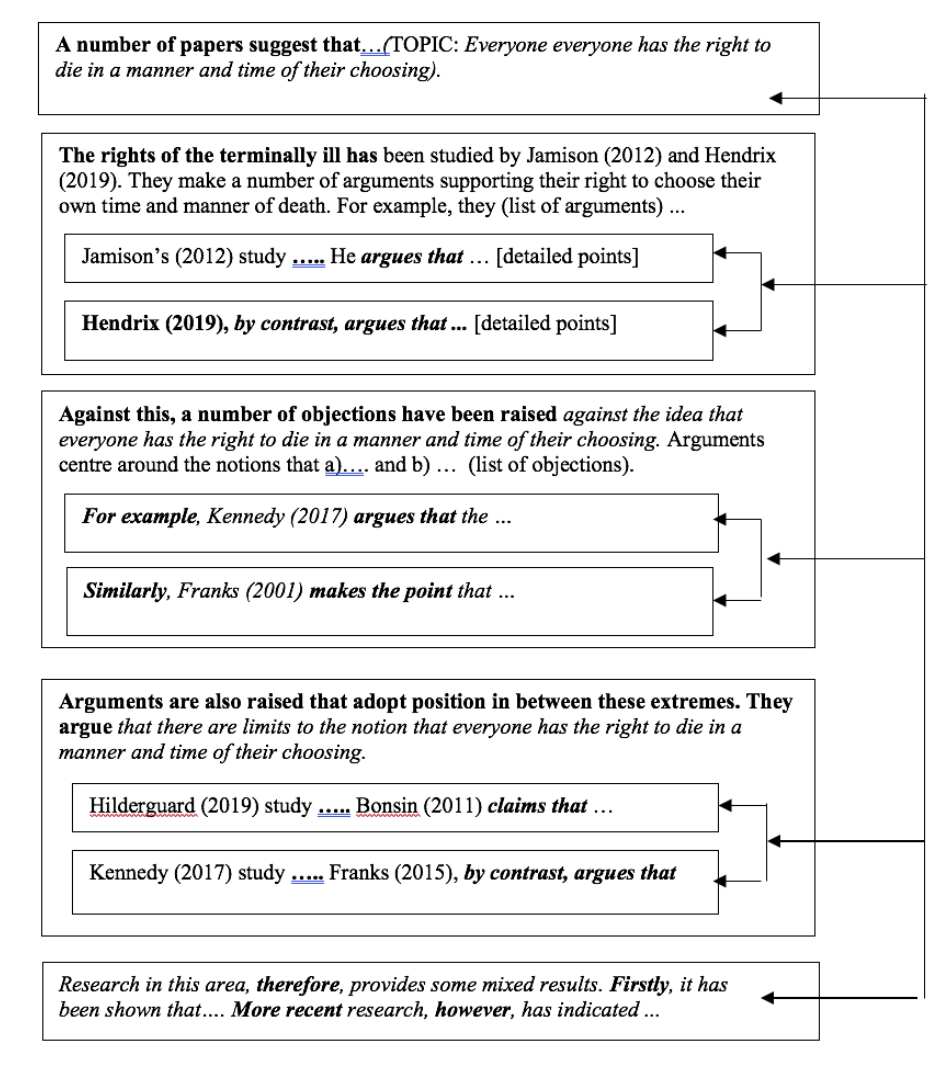
The first box represents the Introduction that sets the scene. The last box sums up the debates. The body content is in the boxes in-between. Of course, this is simple for the purposes of elucidation.
The ‘vertical’ categories (the “outer” boxes) are:
-
- Literature supporting euthanasia,
- Literature in opposition to euthanasia, and
- Literature supportive/against euthanasia, but with reservations.
They are ‘vertical’ because they add new content ideas to advance the discussion.
The ‘horizontal’ categories (the “inner” boxes) are various arguments or evidence-based considerations for each position. They are ‘horizontal’ as they essentially “fill out” examples of the positions articulated in the vertical boxes.
You now have the beginnings of a literature review! It is merely a matter of filling in the details.
Of course, this kind of outline can be expanded infinitely, as needed depending on the complexity of the review.
Reporting on literature
There are a number of ways to group literature and report on it when writing a literature review. It’s essential to do this. Writing without structure just leads to a big mess of ideas.
Group literature in different ways. Notice the difference in tense in the examples below:
- Difference of approach:
For example: ‘While Jones (2002) argues … Smith (1999 )… claims that …’
- From distantly to closely related:
For example: ‘Smith (1999) and Jones (2001) both showed that … However, Hutchison (2002) demonstrated that …’
- Chronologically:
For example: ‘Early marketing theory owes its development to … Many studies contributed to … for example, Jones and Smith (1986). Hunt (1987) was recognised for … but later Jamison (1999) showed that..’
Use different ways of reporting on data, so that your literature review does not sound monotonous:
- Information prominent:
For example: ‘Research indicates that … (Becker, 1997, p. 9).' (present tense)
- Weak author prominent:
For example: ‘Research has shown/Some have argued that … (Becker, 1997, p. 9).' (present perfect tense)
- Author prominent:
For example: ‘Becker (1997, p. 9) argues that …' . (present tense)
Make use of a variety of different reporting phrases, for example:
- In Becker’s view … (Becker, 1997, p. 9).
- Becker’s point seems to be that … (Becker, 1997, p. 9).
- Becker rejects the idea that … (1997, p. 9).
- Becker questions the idea that … (1997, p. 9).
- Becker investigates the idea that … (1997, p. 9).
- According to Becker … (1997, p. 9).
- Becker undermines the position that ... (1997, p. 9).
Examples with analysis
'Smith (1990) conducted an experiment on fear and self-esteem with 150 undergraduates. In the study he tested subject self-esteem and then exposed subjects one at a time to a fear-inducing situation. He found that those with lower self-esteem felt greater fear. Jones and Jones (1982) surveyed elderly residents. The respondents who had the greatest independence, self-esteem and physical health, had the lowest degree of fear of being a victim of crime …DeSallo’s study (1984) of 45 college males found that those who had the greatest self-esteem felt the least degree of fear. Yu (1988) found the same for college females … '
Analysis
- A list of experiments. It’s merely a shopping list of experiments without analytical depth. “He found … she found…”
- No clear position of the writer (no writer's voice).
- The point of the review, the gap, is not clear.
- Lack of subtlety in expression. No use of tentative, modal expressions like ‘seem to indicate’… There is no appreciation that there are few “hard facts” in academic scholarship.
'People with greater self-esteem appear to be less fearful. Laboratory studies with college students (DeSallo, 1984; Smith, 1990; Yu, 1988) find a strong negative relationship between self-esteem and fear. The same relationship was found in a survey of elderly people (Jones & Jones, 1982). Only one study contradicted this finding (Johnson, 1985). The contradictory finding may be due to the population used…'
Analysis
- Attempt made to provide analytical balance, comparing one view with others.
- Attempt to draw a conclusion about the data: “This contradictory finding may be due to…”
- The writer’s voice is emerging.
- Use of modal expressions: ‘appear to be less fearful…’... ‘may be due to’…
- No clear gap.
The apparent differences between agricultural marketing and business marketing theories may not present a problem because both disciplines examine issues which are likely to require different theories and techniques for analysis (Henderson, 1999). [However, concern must be expressed at the failure of researchers to comprehensively examine the marketing strategies undertaken by individual farm businesses.] Businesses in the agricultural sector include farmers and other often larger and more sophisticated agribusinesses, such as input suppliers and merchants (Jackson, 2000). Business literature contains published articles examining the marketing strategies of large agribusiness companies; however, [little research appears to reach down to the farm business level.] (McLeay & Zwart, 1993).
Analysis
- Research gap is clear shown in [bracketed text]
- Writer’s voice emerges clearly from reviewed text
- The writer is controlling the review for their own research purposes. They use the literature as support for their own perspective that has been drawn from gaps in the research work of others.