
Reflective writing
Reflective writing is all about considering how your own experiences, understanding and beliefs influence your professional practice, and vice versa.
Reflective writing is one of the few assessment tasks in which your personal experience is central to your discussion. They are designed to focus on a situation you participated in, such as a placement, and explore why it happened the way it did. Looking back and analysing your experience helps you to gain a deeper understanding of your actions, decisions and reactions.
When you connect your experience with key theories and course content, you can start to see how it all fits into your professional practice. Like any skill, reflective writing takes practice. It will become easier, and more natural, with time.
Write a reflective journal
A reflective journal is a record of an experience you have had or are undergoing. Generally, journalling is a cumulative process, one that is written over a specific period. At university, it often relates to an experience such as teaching rounds or nursing placements, or to weekly studio practice.
Your entries detail and discuss your experience in relation to relevant theory and practice. Journal entries generally record the date, and the style and structure can differ widely depending on the discipline. For a model specific to your area of study, refer to your lecturer or tutor.
Like academic writing, the language of reflective writing needs to be clear and professional. The main difference between the two genres, however, is that personal language is encouraged in reflective writing. This is because personal pronouns like ‘I’, ‘me’, ‘my’, etc. reflect your own thoughts and opinions, and these are an intrinsic part of the writing, like writing a personal diary.
A structured process can help us to discover more about ourselves so that we can improve our practice. Gibbs' Cycle of Reflection prompts us to capture and consider our feelings and actions in defined stages.
Gibbs' Cycle of Reflection
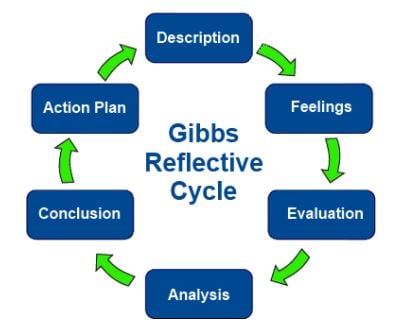
Source: https://images.app.goo.gl/bbAG2JNUQPnry3PHA
- Description: describe the context
- Your initial observations, including sensory details (seeing, hearing, smelling, touching, tasting) and interactions.
- Describe what happened - the event, problem, altercation or interaction.
- Feelings: describe what you were thinking and feeling
- Name your personal reactions, e.g., shocked, afraid, frustrated, angered.
- Consider the range of your feelings, and what beliefs may be responsible for them (i.e., personal, cultural, ideological)?
- Evaluation: explain what worked well/what was good, and what could have been better/what wasn't good
- Use your description and feelings sections to explain why and how the situation was troublesome, challenging or difficult.
- Give details about 'sticking points' for you or for others, relating to actions, beliefs, knowledge, or power dynamics, for example.
- Analysis: extend your thinking
- Relate the incident or situation to theories, readings or other learnings in your study.
- What other perspectives can you use to analyse your scenario or incident?
- Conclusion: what have you learned?
- What could you have done differently, and what have you learned?
- What new knowledge do you have that will influence future choices and actions?
- Action plan: what you intend to do
- What actions do you intend to take now?
- Will you try these actions in similar or different situations?
- What steps will you take to improve your technique and adapt your practice?
- Outline how you might identify change in your practice, with a time limit to complete these steps before you reflect again on your development.
Adapted from: Gibbs, G. (1988). Learning by doing: A guide to teaching and learning methods. Further Education Unit. Oxford Polytechnic: Oxford.
Often, our opinions come easily. But it can take effort to determine why you hold certain views on a topic, and this is something that reflective writing tasks seek to find. Being able to uncover your personal influences, and their likely origin, is part of developing as a professional. The process of developing self-awareness helps you to learn and potentially overcome obstacles that impact your daily life.
To get you thinking more deeply about the task at hand, ask yourself these questions:
- Have your personal beliefs been challenged or confirmed by the course materials?
- What are the 'sticking points' for you or others relating to actions, beliefs, knowledge, or power dynamics? For example, what is challenging your beliefs system?
- What perspectives/theories from your course material are relevant to the experience you are asked to reflect on? Could they explain the issue?
- What other scenarios or perspectives can you use to analyse the scenario or incident?
- Have your initial feelings, assumptions and knowledge been reinforced or changed?
- What new knowledge do you have that will influence future choices and actions?
Here are some handy phrases you can use in your reflective writing. Also check your marking guide for any advice from your lecturer.
Describing and interpreting
Use the past tense to describe and interpret specific events or experiences. However, when describing an idea (e.g., a theory or model), use the present tense, e.g., 'Social interdependence theory recognises…'; (not 'recognised').
Try to define the most important or relevant part of your experience. How can your experience, event or ideas be explained in the context of the theory? Consider how alike or different your experience was from others' perspectives.
Examples
- For me, the most meaningful aspect of the experience was …
- I felt the most significant issue happened when …
- At first, I felt that …
- At the time, I thought that …
- Later, I realised that …
- Alternatively, this may be explained by …
- This is similar to … because of the way …
- Unlike … this demonstrates …
Summarising and projecting
This includes the outcomes, such as what you have learned from the experience, and how that will impact on your future responses.
Examples:
- Having analysed … , I now think that …
- Having read … , I now question …
- Furthermore, I have learned that …
- Significantly, I have realised …
- I have slightly improved my ability to …
- This makes me feel …
- This understanding will be essential to me as a learner because …
- Because I have not yet … , I will now need to …
- As a next step, I need to …
Adapted from: University of Portsmouth (2015). Reflective writing: A basic introduction. Retrieved from http://www.port.ac.uk/media
/contacts-and-departments/student-support-services/ask/downloads/ Reflective-writing—a-basic-intro.pdf