
Plan your assessments
Planning before you start will make the writing process easier and helps you meet all requirements. In other words, planning can help improve your grades. Read on for tips on how to manage your time, break down tasks, and complete your assignments effectively.
The planning process
When you understand what the assessment task is asking you to do, and you have checked the rubric to make sure you know how your work will be marked, it is time to plan.
Planning your time and the steps involved to tackle your assessment are important because it allows you to:
- Make the workload of the task achievable
- Ensure the content meets the task requirements and marking guide
Before you dive into content planning, take a few minutes to map out your timeline for the work involved in completing the assessment. You might like to use a weekly planner or other visual aid.
Write down:
- The task due date
- How much time you realistically have to work on the task each day / week
- Other commitments
Next, follow the steps below to develop a plan for the task itself. Then compare it with your timeline and allocate study time for each step.
A guide to break the task down:
- 1 day to understand your task instructions and brainstorm
- 2-3 days for research and notetaking
- 1 day for developing a plan for your task
- 3-5 days for drafting
- 1-2 days for editing and revising
Tip: Work backwards from your due date. Set smaller deadlines for each stage and add them to your calendar or planner.
For example:
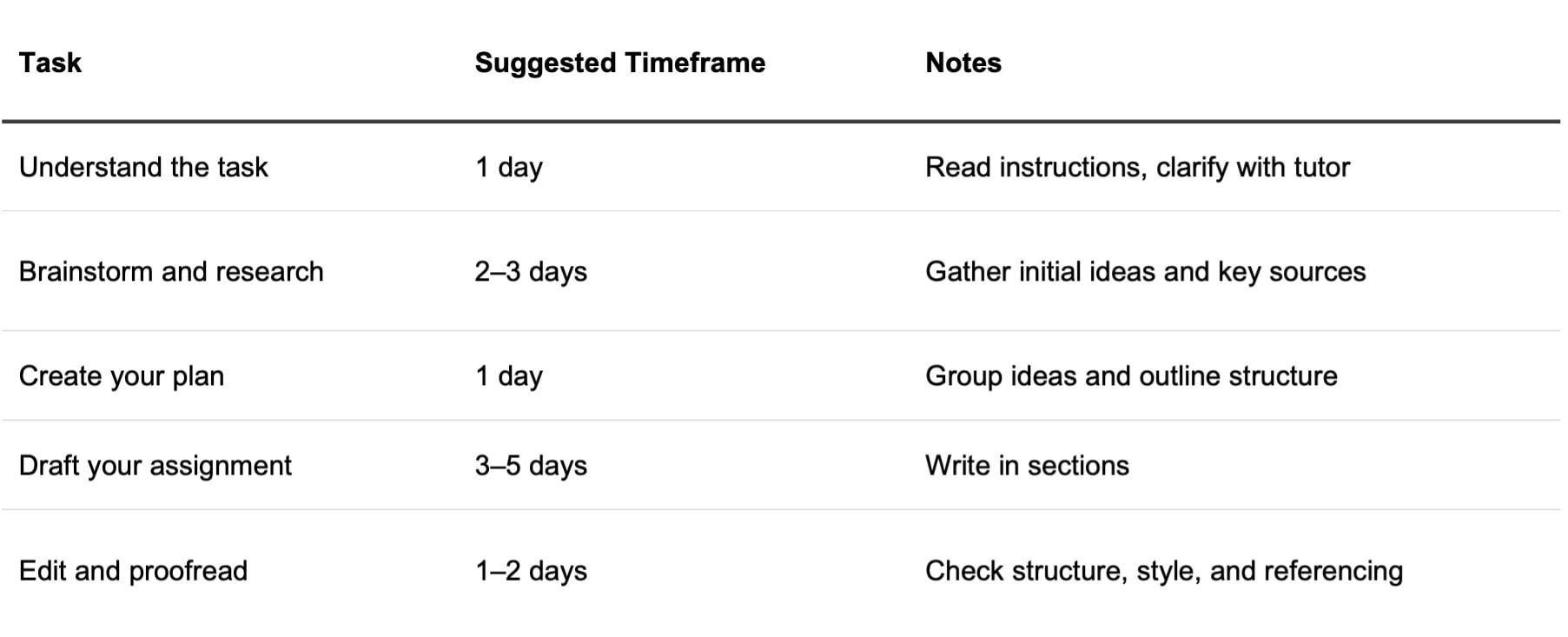
Misunderstanding task instructions can lead to lower marks. In contrast, a good understanding of the task enables you to answer the question and meet the task requirements.
Before you start writing, make sure you know what your task is asking you to do.
- Overview: Look at the assignment title, instructions, and rubric.
- Task type: Have you been asked to write an essay, deliver an oral presentation, write a report...or something else? Identify the type of task - each has its own requirements. Knowing the type of task will allow you to learn more about the conventions of the assessment you have to produce.
- Analyse: Highlight key verbs like 'analyse', 'compare', 'evaluate', 'describe', 'discuss'. These are instruction words that guide how you need to write.
- Word count: Determine how long your task needs to be. This will not only help you break the task down but also create a structure later, once you know more about the topic.
- Resources: Identify how many journal articles, textbooks or other resources you are required to reference. This number is the minimum needed, and it guides the scope of your research.
- Finally, note any formatting or submission requirements so that you can be sure your response is presented the right way.
Remember that assessment tasks are designed to relate to course content that you have learned already. This means that you probably already know more about your topic than you expect!
Brainstorming is about capturing everything you already know about a topic. It is useful because it helps identify your current understanding, knowledge, and any gaps. Brainstorming can also spark ideas to expand on or identify areas to explore further through the next step: research.
How to brainstorm:
- Write down everything you already know, even small points — no idea is too small or insignificant.
- Refer to your lecture notes, textbooks, previous assignments, or discussion boards.
- As you brainstorm, ask: 'What don't I know yet?' 'What needs more evidence?'
- Circle or highlight ideas that require further research.
- Group similar ideas together (themes or subtopics).
Academic writing is almost always evidence-based. This means that you need to build your arguments and ideas with the support of evidence from research.
You may be asked to include evidence from reputable sources such as:
- peer-reviewed journals
- textbooks
- professional guidelines
- government websites
As you identify relevant sources, read and make notes on them. It is good practice to paraphrase the ideas presented in each source, so that when you come to use your notes you can be confident that they are already in your own words. This means you can include an in-text citation for the sources without being concerned about plagiarism.
Tip: Consider using a readings matrix to keep track of the bibliographical information related to each source you've read alongside your notes.
A readings matrix is a table or spreadsheet with columns for recording source information alongside the key ideas or arguments arising out of the source.
Once you have brainstormed and gathered research, you need to plan your response to the task. This involves organising your information before you start writing. A clear plan saves time and minimises rewriting later.
Group your ideas together with your research in your plan so your writing will be more effective. This way you can see at a glance which topics you will be writing about, and in what order, right from the start.
Step 1: Group your ideas
Using your brainstorm and research notes, ask:
- Which ideas belong together?
- Are some points examples or evidence for others?
- Are there any ideas that don't fit the topic?
Try colour-coding your topics on paper or using digital sticky notes to organise and group your ideas.
Step 2: Order your ideas
Once ideas are grouped, decide on the order you will present them in. Aim for one clear idea or argument per paragraph.
Step 3: Plan your paragraphs
If you are writing an essay or other task you will need to work out what to cover in each paragraph.
For each topic you have planned, jot down:
- The main point or topic.
- The supporting evidence or examples you plan to use (include source references).
- How each individual paragraph connects back to your overall argument.
Step 4: Check your plan
Before you move on to drafting, double-check that your plan:
- Addresses all parts of the assignment question
- Follows the required structure or word count
- Meets the criteria in your rubric or marking guide
- Includes reliable, relevant sources for each major point.
If you are unsure whether your plan is accurate, or whether you are on the right track, you might like to show it to a Learning skills advisor before you start writing.