
Essays
Strong essays are built with structure, purpose, and evidence. They're your chance to craft a clear, confident argument that makes an impact. Learn how to plan, write, and polish your ideas step-by-step.
Essays are a big part of uni life. You'll write them for almost every subject throughout your degree. They'll start short and simple, but over time they'll get longer and more sophisticated.
Academics write them too, for conferences, presentations, and publishing research (they call them 'papers').
This page walks you through:
- What essays are for
- How to plan and structure them
- What each section needs and how to write it well.
Read on for practical advice to shape your ideas into clear, confident writing that gets your message across.
Essays are different across disciplines
Each discipline has its own stylistic preferences and genre conventions when it comes to academic writing. An essay for biology will be very different from an essay for visual arts or philosophy. Economics essays are different from essays in marketing. Some essays require an empirical (scientific) methodology; others require theoretical analysis and critical interpretation of text; others require personal reflective analysis; others are different again.
Listen carefully to your lecturer when they tell you what they are looking for in an essay. Be sure to read the assessment task fully and do a topic analysis.
Fortunately, the ‘essay’ as a writing genre has universal elements too: those of structure and academic writing style. Crafting an essay involves learning many transferable skills, including how to:
- develop a succinct, clear, scholarly writing style
- defend a point of view with evidence
- construct an academic argument
- marshal sources, cite and reference
- use established conventions that are applicable in all professional-level writing.
These skills are all useful in the workforce. The ability to write in a professional way is relevant to all areas of employment. It is therefore wise to take the process of learning to write essays seriously.
This is a general guide, and not specific to your discipline. Should you have any specific questions about the structure of your essay, ask your tutor or lecturer.
Different types of essays
In general, your main goal in an essay is to present information about a topic along with your point of view on it. There are two main forms of essay, argumentative or reflective.
Argumentative
Argumentative essays analyse or interpret an event, problem, situation, or theory; and they argue a point of view about that event/problem/situation/theory; and they provide evidence to support the argument.
Reflective
Reflective essays typically either 1) describe a situation and present a point of view about an issue of concern that you have experienced; or 2) evaluate a situation that you might experience as a professional and draw conclusions about how to deal with it.
Occasionally you may be asked to write descriptively and reflectively. This occurs in subjects like nursing and allied health professions subjects, in psychology or community welfare disciplines. Usually, however, you are expected to analyse, discuss or evaluate an issue, applying research to support an argument.
Either way, your essay should always have one major aim, which defends your point of view.
Planning and structure
Having a plan before you start writing will provide direction. It will allow you to map the topic and align your research with each paragraph. Read about the planning process in detail.
Structuring simplifies the process of writing. It may help to think of structure as the skeleton of your writing - if your body was missing a skeleton, you’d flop around. Essays without structure do much the same.
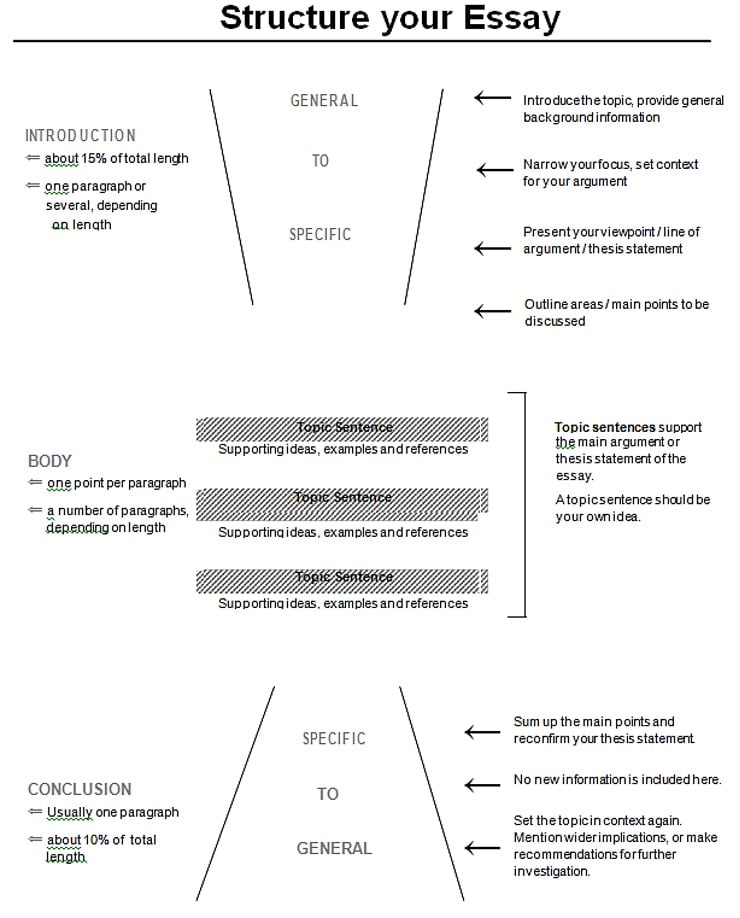
There are three main parts of an essay: the introduction, the body and the conclusion. One simple and memorable way to describe each part is as follows:
- Introduction: tell them what you’re going to say
- Body: say it
- Conclusion: remind them what you just said
That’s oversimplifying it, but it’s a quick way to remember the purpose of each section. Take a look at this visual outline of essay structure:
Introductions
Body paragraphs
The body consists of a series of paragraphs, and each paragraph should cover only one topic. A key to writing effectively in the body of your essay is to include topic sentences.
The topic sentence tells the reader what the paragraph is about and is written in your own words. Using the original essay topic on sports, drugs and adolescents, you might start your first body paragraph with:
Inevitably, being a professional athlete in Australia means there is the additional responsibility of becoming a role model or the 'face' of a sport for younger generations.
There should be no need to reference this sentence as it is supposed to be your idea that you have developed based on your own research. Following this topic sentence would be evidence (examples and references) for your statement that explores and justifies why this is the case.
Conclusion
The conclusion is where you wrap it all up. It’s much like the reverse of the introduction in that you remind your reader what the focus of your essay was. This includes your thesis statement, and an outline of your arguments from the body. You then close with a general statement such as any recommendations about further research that could be done (if that’s appropriate), or a general summary sentence. There should be no new information in the conclusion or any references. If a point is important, it should be in the Body. The conclusion is your own summary of your essay and what it has achieved.