
Managing your time
Balancing study with everything else doesn’t have to be stressful. A few simple strategies can help you stay organised and focused.
If you’re balancing study alongside work, family, friends, or hobbies, being organised can make a big difference. A few simple strategies can help you stay on track and reduce stress.
Learn here how to:
- build a schedule that works for you
- keep track of what matters most.
Start planning today and set yourself up for success.
Time management strategies
Using a visual aid such as a wall calendar or planner is a great way to remind you of the big picture. Seeing the whole year or semester at a glance is one way to keep things in perspective.
It is also an effective tool for planning, particularly by adding academic and social deadlines. You'll quickly see which weeks of semester may dampen your social life.
On your calendar, include things like:
- semester dates
- assignment due dates
- exam times
- personal events.
Adding these commitments to a yearly planner gives you a structure to work around. Crossing items off as they are completed will help you feel a sense of progress.
While this is great for the big picture, a wall planner does not have space for the details of your tasks. Consider using a diary also, in which you can break down your tasks into the smaller, practical ones you'll need to do to get your work done.
The job of planning is hard if you don't know what time you have available for study. Do you know what time is NOT available each week? This will be time that is for:
- scheduled classes
- travel to and from uni
- preparing and eating meals (your meals and/or the family's)
- sleeping
- shopping and domestic activities
- working (paid employment or volunteering)
- parental responsibilities
- regular recreation activities like sport, going out, visiting friends.
Use the Weekly Planner helpsheet (PDF - 131KB) to find out what time you have available for study outside the classroom. If this is less than 10 to 15 hours then you really don't have much choice about when you study. The approach you will need to take will be different from a student who has more than 10 to 15 hours of 'free time' per week. With little spare time, you will need to be more goal-orientated and avoid procrastination.
Goal setting is helpful in several ways. It is motivating: you have a specific thing to strive for. Achieving a goal, regardless of how small it is, also helps prove to yourself that you CAN manage your time. By setting and completing manageable goals, it makes you feel like you are making progress and being productive.
You can set goals at the beginning of a week, a day, or even a 30-minute study session. When you set these goals, remember to be SMART:
- Specific: What do you want to do? "Finish my assignment" could be overwhelming, so try to break a task into smaller, more manageable goals.
- Measurable: How will you know when you've completed the task?
- Achievable: Are you capable of accomplishing this task? It is good to be aware of your own strengths and limitations here.
- Realistic: Can you realistically achieve it? For example, most people would not be able to finish a whole assignment in one day.
- Time-based: When exactly do you want to accomplish this goal by? This ties in with choosing a goal that is also realistic and achievable.
With the details of your study tasks recorded in your diary (or equivalent planning device), set yourself practical goals to achieve specific activities. For example, to write an essay, your goals might be to:
- choose your topic
- analyse and research it
- organise your information
- write your first/second/third/fourth draft
- edit, proofread, check layout and presentation.
Being able to prioritise tasks is an important skill, not just for study but also for life in general. Luckily, that skill can be learnt quite easily.
- Make a list of everything you have to do.
- Using the grid below, identify what really needs to get done.
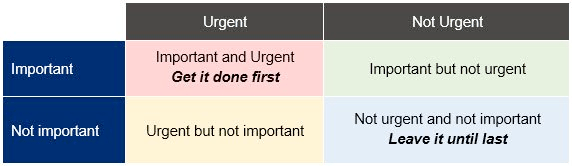
- Weigh up the relative importance and urgency of your tasks to help you prioritise.
- Set some SMART goals.
- Remember to be flexible and adaptable because priorities can change and you are allowed to change with them.
Now you've organised what you need to do.
Get to work!
Planning, goal setting and prioritising are important steps in increasing your productivity. Spend a few minutes each day reviewing your plan, goal's and priorities before you start studying. This will drastically improve your productivity. Doing these steps you help you to study smarter, not harder.
- It is also important to remember that you need to be kind to yourself when you don't meet your goals, and reward yourself when you do!
- If you struggle to get work done alone, study with a friend or join a "study with me" session online instead – they are great for holding you accountable.
- Finally, remember to choose the right study space, whether that be at home, in a library, in a cafe or in a park. Everyone works differently and you should allow yourself the time to find out what works best for you.