
Changing the game for knee injuries
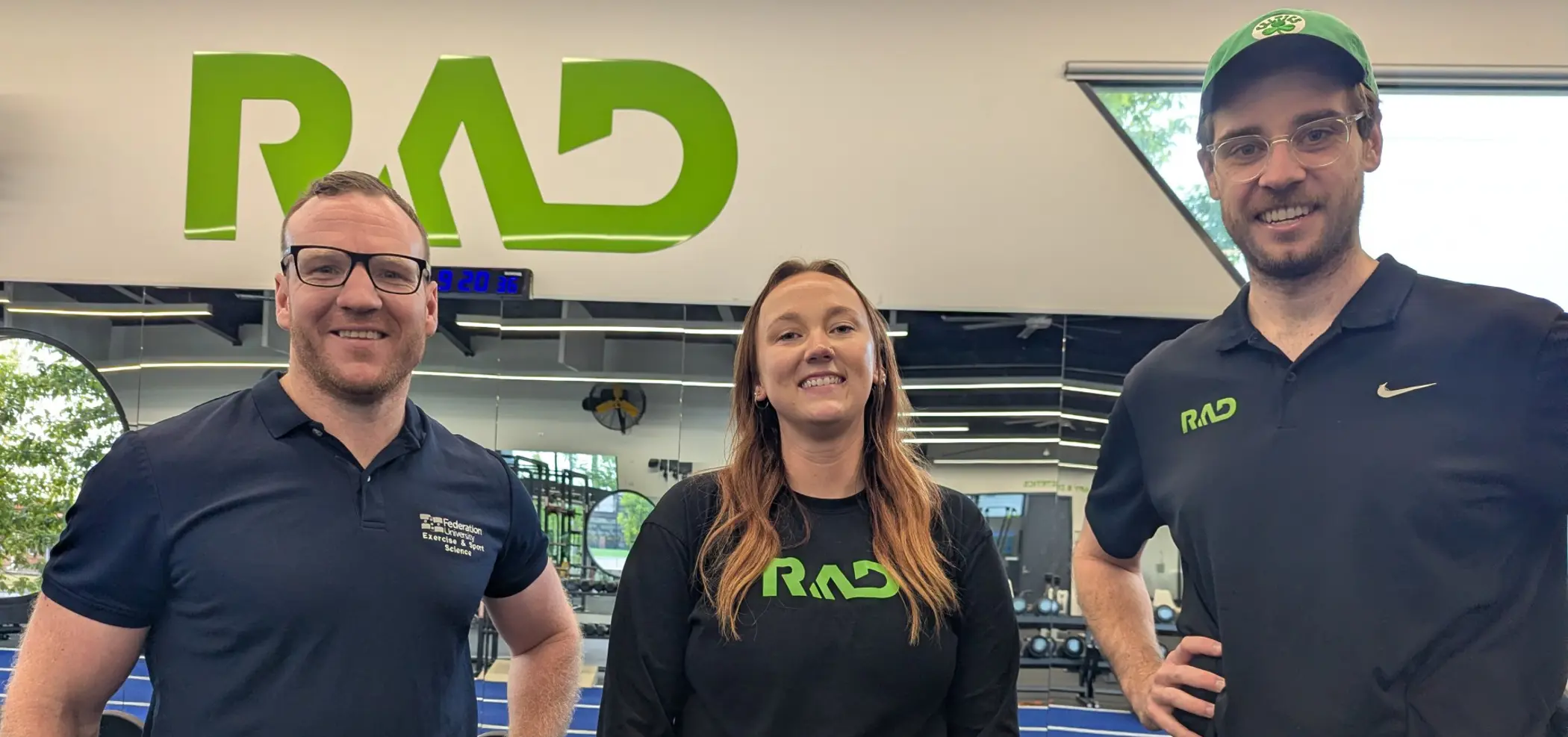
Federation University Exercise and Sport Sciences Lecturer Dr Mathew O'Grady, PhD student and RADCENTRE strength and conditioning coach Madison Sanford and RADCENTRE head of performance and education Tim Welsh. Image: Supplied
For athletes, few acronyms induce as much fear as ACL. The anterior cruciate ligament is an important stabiliser between the thighbone and shinbone and when torn or snapped, the painful knee injury requires surgical repair and a gruelling year-long physical rehabilitation.
Much work has been done researching the prevalence of the injuries and now a collaboration between Federation University researchers and RADCENTRE, a Ballarat-based sports performance and health hub, will look to add to what’s known about ACLs during the rehabilitation and return-to-play stages.
The partnership will see PhD student and scholarship recipient Madison Sanford embedded at RADCENTRE, working on the project while getting experience in the sport rehabilitation industry. Ms Sanford, from Canada, is returning to Australia having completed her Master's degree at Federation previously.
Federation Exercise and Sport Sciences lecturer Dr Mathew O’Grady says the impact of an ACL injury is dramatic and while it is often seen in high-profile elite sports, it’s also common among community-level athletes.
“The reason we hear about it is because of the 9-12 months – or more – that people are out before they're returning to play. It's a long process and it has a big effect on the individuals who go through the recovery,” Dr O’Grady said.
“Reinjury rates with ACLs are also still high. Many sportspeople out there have done an ACL injury, had the surgery, do the rehabilitation and then they might not necessarily be the same athlete they were pre-injury.
“We have seen some types of injuries are starting to decrease but we haven’t quite been able to control ACLs, so there's a large amount of research that's going on into the best protocols to try and minimise that injury risk.”
Dr O’Grady, who is also a strength and conditioning coach, says the partnership with RADCENTRE gives the team the opportunity to work with many potential participants of different ages and from different sports backgrounds.
He says the work will add to the “very fast-growing literature around ACL rehabilitation” and will begin with a systematic review to assess different key measurements currently used throughout the rehabilitation process.
This includes examining force plate data – a platform equipped with sensors that measures the force a person exerts on it during activities – and will look at symmetries between injured and non-injured knees, as well as biomechanical analyses of techniques.
From there, the researchers hope to discover whether there are areas of measurement that haven't been previously considered.
“That's where we want to explore a little bit more – seeing how athletes are actually recovering by doing different tests with the force plates,” Dr O’Grady said.
"There hasn’t been much research looking at athletes when they return to play, and we want to know what happens to their performance. These projects will relate to one another, giving us a more holistic view.
"We are reviewing what has been done, looking at new measurements, and comparing them to the previous gold standard in the literature. Finally, we’ll be asking: now that we’ve gone back to sport, what’s next? What happens now that they're actually back playing the game they love?"
The Co-operative Education Model partnership sees RADCENTRE director Chris Radford, a Federation sports science degree and honours graduate, team up with former classmate Dr O’Grady.
RADCENTRE is a comprehensive sports physiotherapy and performance centre, combining rehabilitation, strength and conditioning and dietetics to help athletes of all ages to recover faster and achieve peak physical condition.
“Madison saw the PhD opportunity, applied, and has moved back to Australia for this. She is working at RADCENTRE as a strength conditioning coach while also working on her PhD, so it's a fantastic opportunity,” Dr O’Grady said
“There’s lots of reading and getting through the literature but the foundation for the PhD has been set and she will be working with athletes and participants who are going through ACL rehabilitation, while assisting RADCENTRE on the gym floor.
“It's a perfect example of where a PhD project is actually embedded specifically to the industry, so the industry partner is getting benefit and the student is working in their chosen field while completing their PhD.”