
New publications aim to empower the next generation of Indigenous researchers
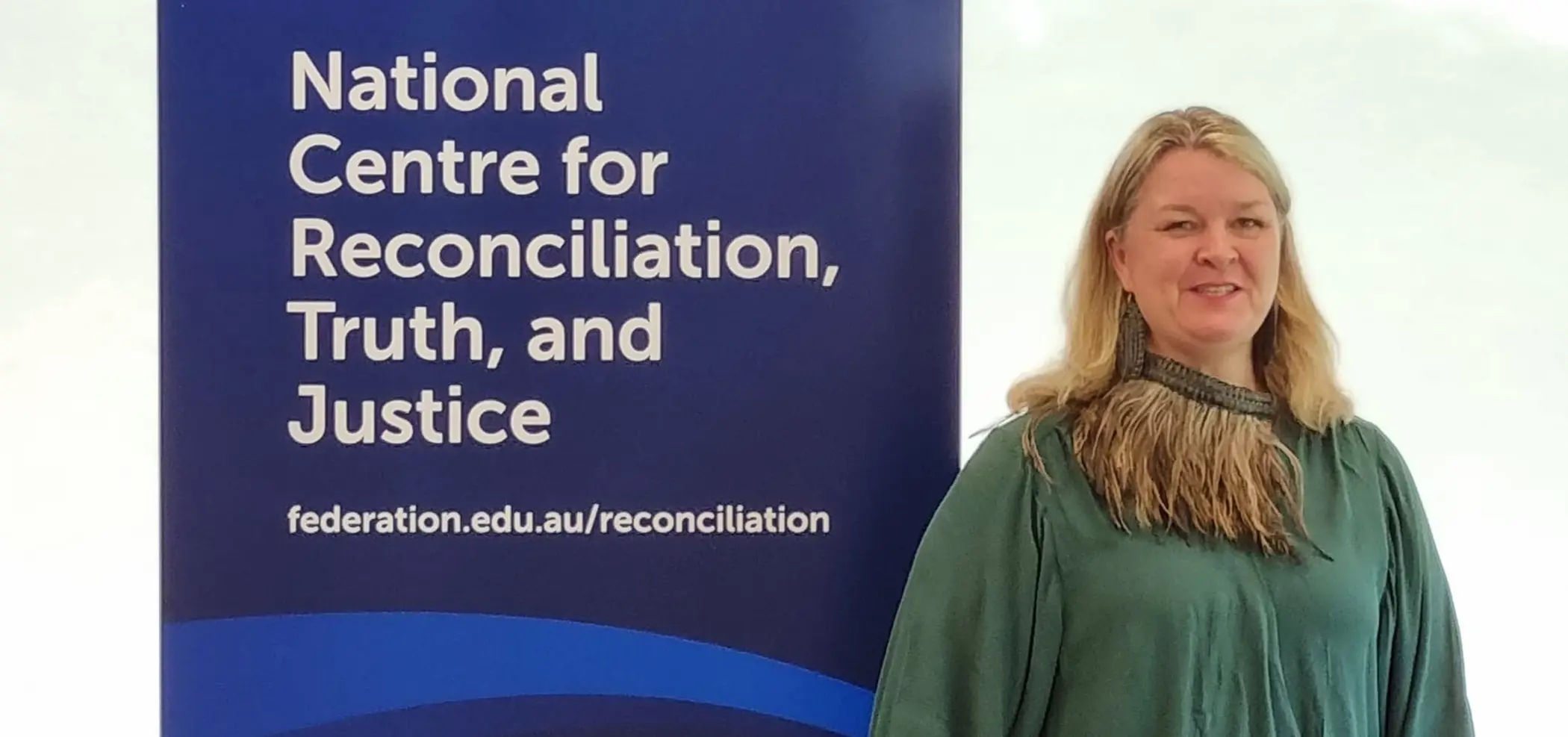
Professor Bindi Bennett says she is always looking to empower the next generation of authors.
A Federation University researcher has edited two new books that showcase the diverse and influential contributions of First Nations academics and will help to pave the way for the next generation of researchers.
Professorial Research Fellow at the National Centre for Reconciliation, Truth, and Justice Bindi Bennett is the lead editor of the publications Indigenous Research Knowledges and their place in the academy and the soon-to-be-released Aboriginal Social Work Voices.
Professor Bennett says Indigenous Research Knowledges and their place in the academy highlights the importance of Indigenous Peoples in research and advocates for storytelling as a key part of academic work.
She says the book, co-edited with Professor Kelly Menzel, is aimed at students and early career researchers, especially those from Indigenous backgrounds, and serves as a helpful resource for non-Indigenous people.
Professor Bennett says the book shows that Indigenous research is on the same level as Western research and is a valuable resource for researchers worldwide to better understand Aboriginal (Australian) Indigenous research.
"We try to come to the books in a relational and ethical way, so there's often a big conversation about the methodology being Indigenous, grounded in country, kinship, in stories and de-westernising some of the way that we do books," Professor Bennett said.
"Both of the books speak a lot about Indigenous sovereignty, new knowledge creation and re-vitalising Indigenous knowledges - transmitting that First Nations knowledge and talking about it in research and in practice as a new or different or diverse way of coming to things."
Professor Bennett's research is underpinned by a commitment to improving and growing cultural responsiveness, re-Indigenising Western spaces, and understanding and exploring Indigenous Knowledge Systems.
Her academic journey began after a 20-year career as a social worker in mental health, specialising in trauma.
As a leader in Indigenous social work and an editor, she says she is always looking to empower the next generation of authors – advocating for them to prioritise Country and define their own narrative.
The second book, Aboriginal Social Work Voices, is the third volume in a series that began with Our Voices – a ground-breaking collection of writings from Aboriginal social work educators, covering new and innovative approaches to how social work practice can be developed, taught and delivered in ways that more effectively engage Indigenous communities.
Our Voices was published in 2013 and is included in 73 university libraries across the world, and with the latest publication means there will be more chapters of knowledge from Indigenous social workers.
"Both new books come from a similar place, and that is wanting to show the world that there's a diverse and powerful array of First Nation scholars out there, as well as community leaders, and practitioners.
"It's now about making sure that I bring all those other people behind me, but not just into academic conformity, but in their own rights to be able to have their voice and their experiences respected and heard – it's like leading by doing in some ways."
Professor Bennett says the books were creating platforms for Indigenous scholars to talk to truth-telling, share their lived experience, and reflect on their practice experience.
"Rather than it being that abstract other, it becomes the real," Professor Bennett said.
"It's actually quite courageous to write as an Indigenous scholar, and in an Indigenous way. Sometimes it's hard to put your voice out there, and this gives the authors that support to get to the point that it is published.
"It's my job to be accountable to those coming next. I tried to make a footpath to follow – this is one way to do it. "
The National Centre for Reconciliation, Truth, and Justice is Australia's leading academic think-tank on reconciliation. More information about the National Centre can be found on this webpage or by following the centre on LinkedIn