
New MoU unites Federation and FECRI to advance regional cancer research
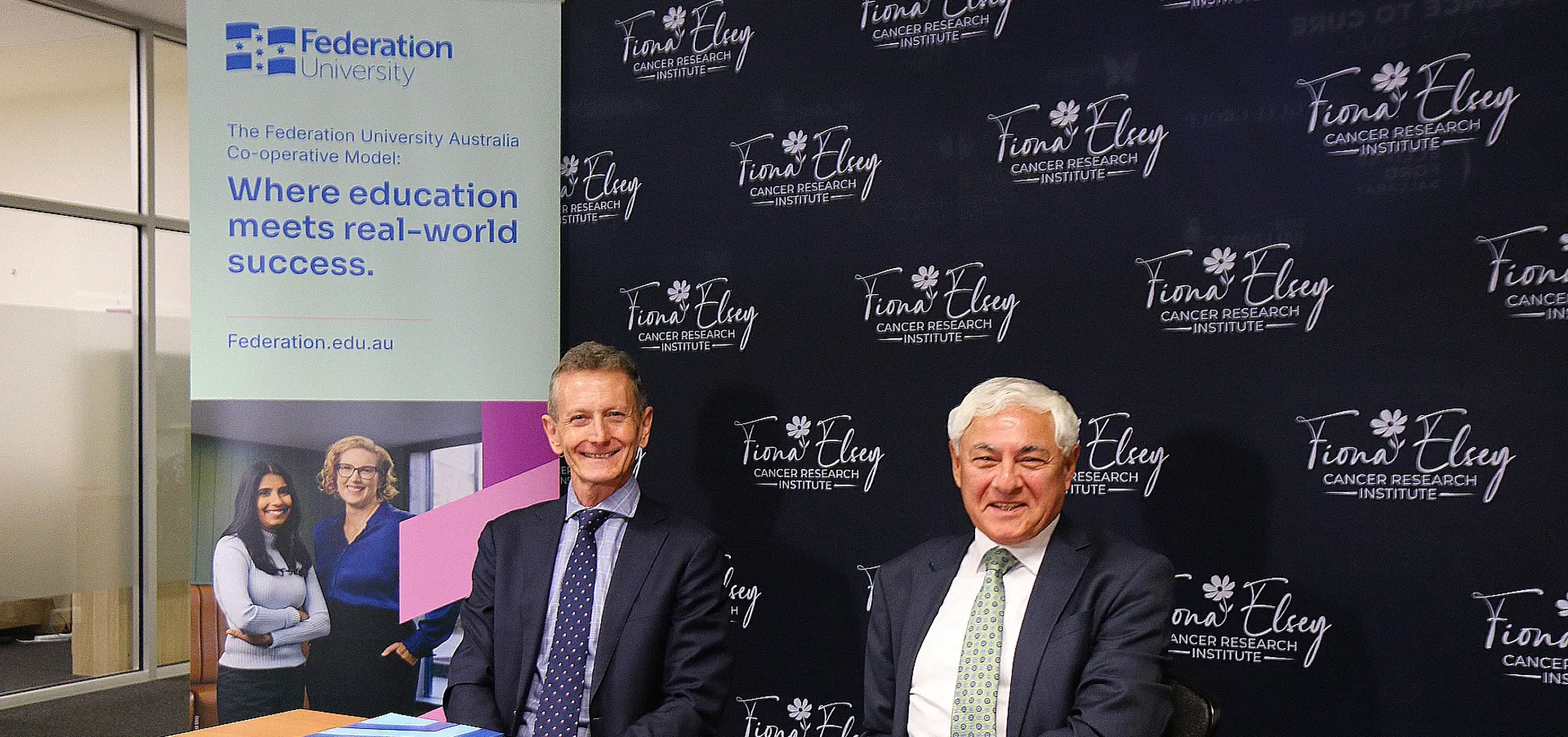
Federation University Vice-Chancellor and President Professor Duncan Bentley and Director of FECRI Professor George Kannourakis.
Advancing regional cancer research and cultivating local scientific talent will be at the forefront of a new partnership between Federation University and the Fiona Elsey Cancer Research Institute (FECRI).
Under a newly signed Memorandum of Understanding (MoU), Federation University – Victoria’s biggest regional university – and FECRI – Australia’s only community funded regional cancer research facility – will work together to strengthen cancer research capability in regional communities.
Outcomes for regional patients continue to lag, with data from the Australian Institute of Health and Welfare showing that people living in remote areas are 1.3 times more likely to die from cancer and experience a lower 5-year relative survival rate compared to those living in major cities.
The partnership aims to help address this gap, giving areas like Ballarat the benefit of a strong medical presence that can help save lives.
The MoU will see the University and Institute explore new opportunities to collaborate on cancer research and development, testing and talent development. This includes providing local students the opportunity to undertake internships and Co-op placements with FECRI, giving them valuable hands-on experience and exposure to real-world research.
Future PhD projects will explore how tumour cell plasticity (epithelial-to-mesenchymal transition) and immune interactions drive therapy resistance in aggressive hard-to-treat breast cancers, integrating spatial biology, immunology, and translational research approaches to identify novel biomarkers and therapeutic targets aimed at improving precision immunotherapy outcomes.
The aim of the collaborative work is to further our understanding of how brain tumour cells "trick" antitumour immune cells to turn into pro-tumour immune cells that help the brain tumour to progress.
Another FECRI project aims to reverse the effects of pro-tumour immune cells using a suite of novel and re-purposed drugs that will make the brain tumour more vulnerable to attack and death.
The partnership further aligns with Federation’s Co-op model, which puts students at the intersection of education and industry, gaining valuable working skills through paid placements while studying.
Quotes attributable to Federation University Vice-Chancellor and President Professor Duncan Bentley
“Much of Australia’s medical and scientific research is concentrated in big cities, leaving regional communities without the same access to innovation, expertise and opportunity.”
“When research happens in places like Ballarat, it brings worldclass science closer to the people who need it most. It means local patients benefit sooner and local students can build careers without leaving their community.”
“It also means that over the coming years, a current Ballarat high school student will be able to go on to study at Federation and have a pathway to do ground-breaking research right here with FECRI”.
Quotes attributable to Director of FECRI Professor George Kannourakis
“Regional Australians continue to experience poorer cancer outcomes, and that gap will only close if research capability is built and sustained in regional communities. We’re grateful to Federation University for recognising the importance of investing in regional-led cancer research.”
“This partnership reflects a shared belief that world-class cancer research does not belong only in capital cities. Together, FECRI and Federation University are demonstrating that high-impact, clinically relevant science can be driven from regional Victoria and deliver benefit well beyond it.”
“Federation University PhD students will work alongside FECRI scientists on aggressive breast and brain cancers, using real patient samples to address questions that matter to patients and clinicians now – not years down the track.”
“Just as importantly, this collaboration helps ensure future cancer researchers can train, contribute and lead without leaving their region, strengthening local expertise where it is most needed.”